This site uses cookies to store information on your computer.

Some of these cookies are essential, while others help us to improve your experience by providing insights into how the site is being used. For more detailed information on the cookies we use, please see our Cookie Policy.

Home
»
VTech Baby
»
Drive & Discover Baby Keys
3-24
MONTHS

This is a carousel. Use Next and Previous buttons to navigate. Or, jump to a slide by selecting one of the thumbnails.

Drive & Discover Baby Keys

Developmental Benefits

Auditory Stimulation
Motor Skills
Motor Skills
Visualisation Memory

Developmental Benefits

Drive & Discover Baby Keys

Auditory Stimulation
  • Fun and interesting sound effects draw baby’s attention to play.
  • Even very early in life babies can hear a wide variety of sounds. Infants will turn towards the sound of a toy and begin to reach towards it. This ability to recognise the direction that a sound is coming from improves greatly during the first few years of life. Young infants listen longer to the sound of human voice and seem to prefer it to any other sound. They are especially aware of the sound of language and like to be spoken to slowly and with a high pitch. This is sometimes referred to as ‘infant directed speech’ or even ‘baby talk’. Young babies are quite sensitive in their auditory abilities and can perceive all the categorical sound distinctions in world languages. As babies develop their auditory abilities narrow so that eventually babies are only sensitive to those sound categories specific to their native language.
    As soon as babies are born they are influenced by what they hear around them and modify what they able to hear, accordingly. At the same time they become increasingly sensitive to music and musical patterns. Even in their first year babies are distinguishing between musical tunes on the basis of rhythmic patterns and later they begin to recognise the same melody played in a different key. Giving babies plenty of opportunities to hear music, singing, rhythm and talk enhances their learning and prepares them for the social world where they will talk, sing, play and listen to music.
Motor Skills
  • Encourages fine motor skill development.
  • An infant’s growth and development in the first year of life is rapid. Many movements that young babies make are in preparation for the next stage of their development. When young babies watch a mobile they are constantly moving their head, arms, legs and even their mouths in response to the movement of the toy. Sound and movement attract a baby’s attention; if a toy is placed almost within reach of babies their movements become more animated. Bath toys provide opportunities to develop and use motor skills to great effect. For example, a young baby has greater control over their leg movements than their arms. You will often see young babies in a bath reaching with their legs towards a floating toy and kicking. All these movements strengthen muscles in readiness for the next stage - walking.
    As babies develop they become more adept at grasping objects. Young infants learn to grasp an object, for instance a cube. The grasping, at first, is quite clumsy but through repetition, and across time, infants become adept at grasping and develop fine motor skills. Infants first use the ulnar grasp where their fingers close against the palm when trying to hold an object. Within another month they are able to move the object from hand to hand. After the first year, infants adopt the ‘pincer grasp’ where they use their thumb and index finger to grasp even very tiny objects. Shape sorters help infants to fine tune their visual perception and hand coordination. Soon infants are building towers with two cubes; this also requires fine coordination skills. As the child grows computer games have been shown to help with hand and eye coordination. Spatial skills can also be enhanced when playing games that require concentration, quick responses and finely tuned motor skills.
Visualisation Memory
  • Engaging graphics & visualisation activities develop memory.
  • As babies develop they begin to use mental pictures of objects that are no longer within their field of vision. These memory skills can be enhanced through presenting visual stimuli more than once; repetition is essential for the development of memory skills. Young infants’ memories are influenced by context; for instance, they can imitate an adult’s actions with a toy but only if the toy is identical in colour and features to the one that the adult played with. Older infants can remember, for instance, how to press a toy animal to make a sound even if the toy is slightly different to the one which the adult used to demonstrate. Infants’ memories become less context dependent at the same time that infants start to crawl and walk. Giving babies plenty of opportunity to explore their world allows them to enhance their memory skills.
    As children’s attention span increases so do their memory strategies. This means that children can use deliberate mental activities, such as visualisation, to increase the chances of retaining information in working memory and then shifting it to their long-term knowledge base. Lots of rehearsal and organisation is needed to use memory to its full advantage; repetition is an important part of both infant and childhood learning. Children can both learn and practice memory strategies using toys and games. Toys that encourage children to remember visual stimuli, answer questions and then repeat the activity over again enhance learning.
Best for ages:
3 to 24 Months
Highlights
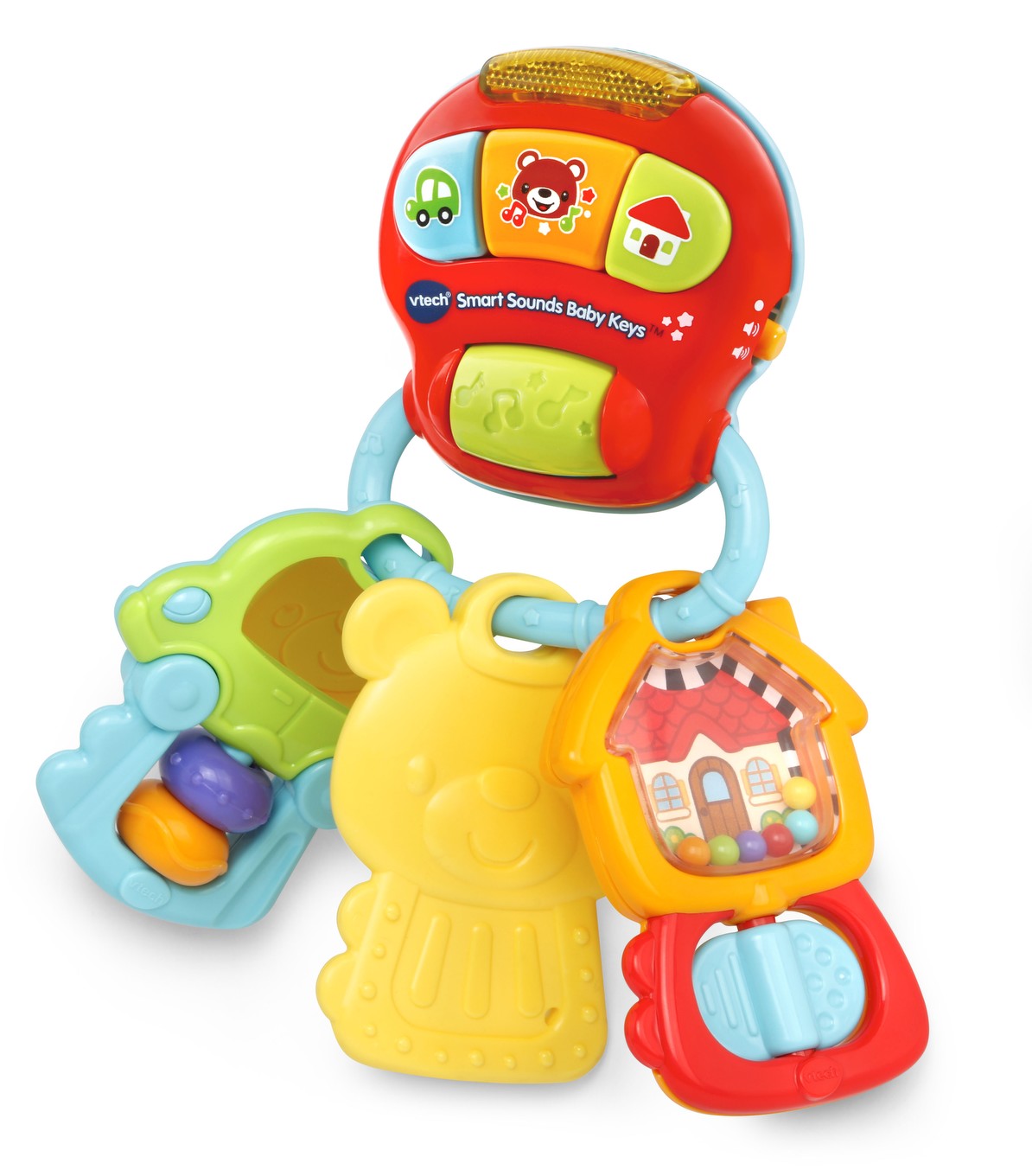
VTech Drive & DiscoverBaby Keys encourage interaction and help develop fine motor skills, while three colourful buttons play cheerful songs, phrases and melodies.
Description
Shake, rattle and go with the VTech Baby Drive & Discover Keys. These adorable baby keys feature three colorful buttons that play cheerful songs, melodies and cute sound effects. The interactive keys feature textured rollers, rattle beads and a spinning disc that encourage fine motor skills and introduce cause and effect. The bear key teether soothes your baby's sore gums. Shake the keys or press the colourful buttons to hear playful sounds and phrases that promote first words, then take the keys along for on-the-go play!

Recommended Products

This is a carousel. Use Next and Previous buttons to navigate. Or, jump to a slide by selecting one of the thumbnails.