This site uses cookies to store information on your computer.

Some of these cookies are essential, while others help us to improve your experience by providing insights into how the site is being used. For more detailed information on the cookies we use, please see our Cookie Policy.

Home
»
VTech Baby
»
Tool Box Friends
12-36
MONTHS

This is a carousel. Use Next and Previous buttons to navigate. Or, jump to a slide by selecting one of the thumbnails.

Tool Box Friends

Developmental Benefits

Language Development
Motor Skills
Motor Skills
Role Play
Role Play

Developmental Benefits

Tool Box Friends

Language Development
  • Introduces the alphabet, letter sounds and vocabulary.
  • Babies start to babble at an early age and this can be seen as the first signs of language. They are predisposed to pick up the sounds of the language that they hear around them. Adults can facilitate babies’ language development by playing with them, focussing on particular toys, reading books and naming everyday objects. The more babies are exposed to language the faster they will begin to pick up it up. There are social skills involved in language acquisition such as realising that it is necessary to wait until the other person has finished speaking. Babies begin to learn about conversational turn-taking from an early age; if a baby is babbling the adult waits for a pause and then talks to the baby. Babies learn to take turns even before they are using words. Social interaction is important for language development and turn-taking games are a fun and educational way for babies and young children to learn.
    Young children also need to practice their language skills. Toys that name alphabet letters and everyday words satisfy young children’s need for repetition and rehearsal when practicing words and sounds. For instance, young children can press a button repetitively to hear the same sound or word again. Babies and children learn a lot through repetition and pick up words rapidly in this way. Once children begin to read their vocabulary expands enormously.
Motor Skills
  • Encourages fine motor skill development.
  • An infant’s growth and development in the first year of life is rapid. Many movements that young babies make are in preparation for the next stage of their development. When young babies watch a mobile they are constantly moving their head, arms, legs and even their mouths in response to the movement of the toy. Sound and movement attract a baby’s attention; if a toy is placed almost within reach of babies their movements become more animated. Bath toys provide opportunities to develop and use motor skills to great effect. For example, a young baby has greater control over their leg movements than their arms. You will often see young babies in a bath reaching with their legs towards a floating toy and kicking. All these movements strengthen muscles in readiness for the next stage - walking.
    As babies develop they become more adept at grasping objects. Young infants learn to grasp an object, for instance a cube. The grasping, at first, is quite clumsy but through repetition, and across time, infants become adept at grasping and develop fine motor skills. Infants first use the ulnar grasp where their fingers close against the palm when trying to hold an object. Within another month they are able to move the object from hand to hand. After the first year, infants adopt the ‘pincer grasp’ where they use their thumb and index finger to grasp even very tiny objects. Shape sorters help infants to fine tune their visual perception and hand coordination. Soon infants are building towers with two cubes; this also requires fine coordination skills. As the child grows computer games have been shown to help with hand and eye coordination. Spatial skills can also be enhanced when playing games that require concentration, quick responses and finely tuned motor skills.
Role Play
  • Develops imagination and encourages cooperation, listening and turn-taking.
  • Role play is a form of social pretend play. Children benefit from social pretend play because it can help them to revisit events that may have provoked some anxiety in the past. For instance, after a visit to the doctors children often play at being doctors and nurses. Role play not only reflects but also contributes to children’s cognitive and social skills. Playing out an experience enables children to understand more about it.
    Research has shown that during social pretend play, young children’s interactions last longer, are more engaging and also more cooperative. Nursery school children who spend more time in socio-dramatic role playing are also perceived as more socially competent by their teachers. Role play enhances many cognitive abilities such as sustained attention, memory, language and literacy skills, and helps children to understand and manage their emotions. Role play is generally a social activity but some children can engage in solitary role play where they create imaginary companions. Games where children can create worlds and populate them with their own characters can be beneficial.
Best for ages:
12 to 36 Months
Highlights
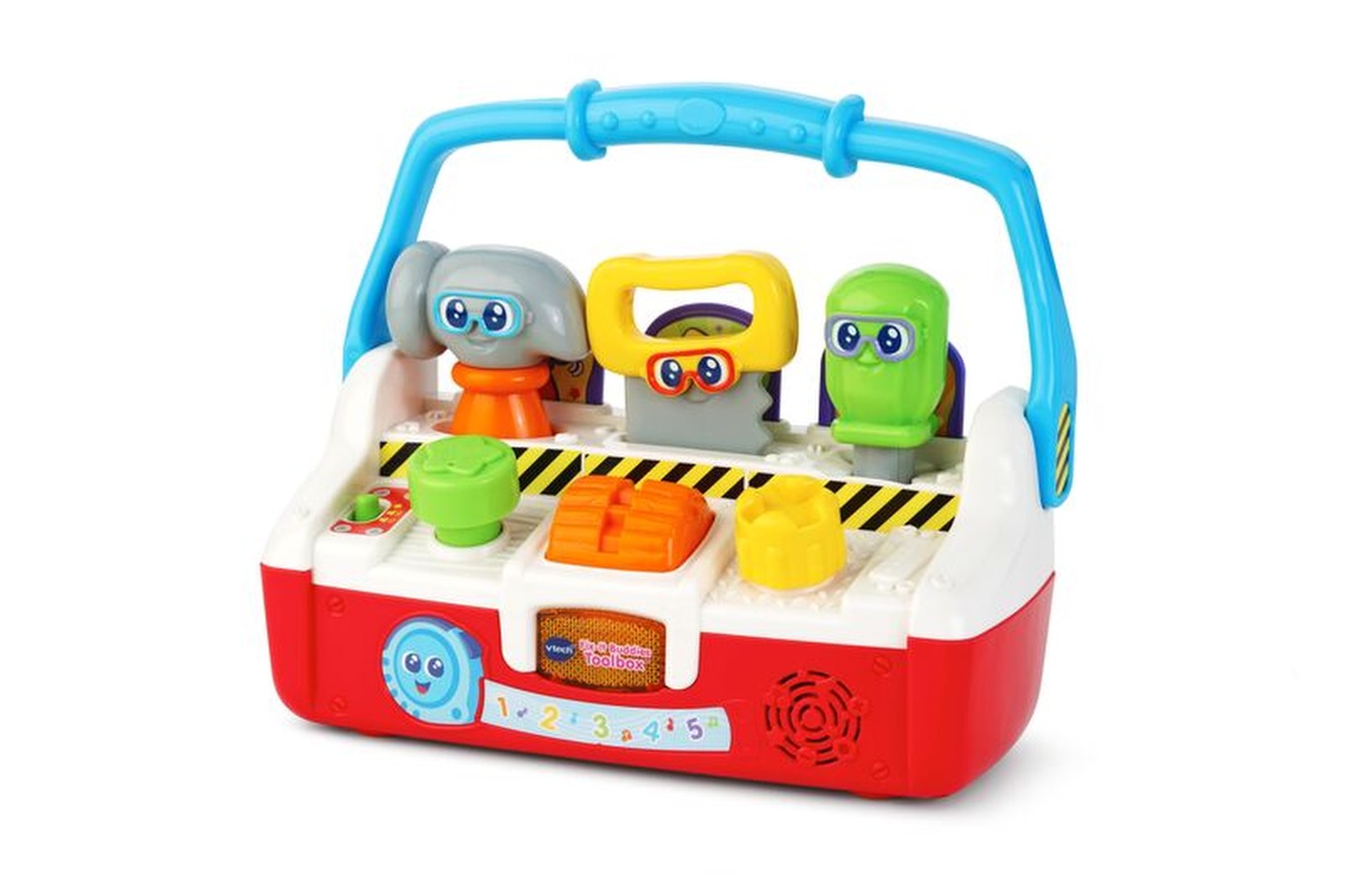
Use the friendly tools to press, roll or turn the nail, screw or wood block to develop fine motor skills. Includes 4 sing-along songs and 15 melodies.
Description
Meet the popping Tool Box Friends by VTech. This bright and colourful tool box is a great toy to support your little ones imaginative play. The 3 adorable individual characters can be taken in and out of the tool box and will encourage role-play and imitative play. Use the friendly tools to press, roll or turn the nail, screw or wood block to support and develop fine motor skills and hand eye coordination. The cute characters also introduce numbers, colours and themselves. There is an easy to grip handle for on the go play. Includes 4 catchy sing-along songs and 15 fun melodies.

Recommended Products

This is a carousel. Use Next and Previous buttons to navigate. Or, jump to a slide by selecting one of the thumbnails.