This site uses cookies to store information on your computer.

Some of these cookies are essential, while others help us to improve your experience by providing insights into how the site is being used. For more detailed information on the cookies we use, please see our Cookie Policy.

Home
»
VTech Baby
»
6-In-1 Playtime Tunnel
3-36
MONTHS

This is a carousel. Use Next and Previous buttons to navigate. Or, jump to a slide by selecting one of the thumbnails.

6-In-1 Playtime Tunnel

Developmental Benefits

Independent Play
Independent Play
Motor Skills
Motor Skills
Tactile Stimulation
Tactile Stimulation

Developmental Benefits

6-In-1 Playtime Tunnel

Independent Play
  • Games and voice prompts allow children to control the pace.
  • Early play in infants tends to be solitary or takes place alongside other children. Young children learn how to interact with other children through play but they can also explore and learn independently. The initial play experience for infants is when they begin to explore through moving and acting upon the world. Many toys offer infants the opportunity to learn more about their world. Young children will sometimes act out some aspect of their lives e.g. going to the shops and then they involve their toys in these activities. These young children are playing independently but they are also reinforcing their understanding of the social world by acting out scenarios.
    Young children can consolidate their existing skills by repeating actions whilst playing a game. Learning to play independently has its benefits, for instance, children using an educational game can control their own pace. Children sometimes choose to work independently in order to build up their confidence. Toys and computer games that facilitate independent activity at the right level for the child enhance problem solving skills and increase hand and eye coordination. Although cooperative play increases during childhood, children still spend the equivalent amount of time in solitary or independent play.
Motor Skills
  • Encourages fine motor skill development.
  • An infant’s growth and development in the first year of life is rapid. Many movements that young babies make are in preparation for the next stage of their development. When young babies watch a mobile they are constantly moving their head, arms, legs and even their mouths in response to the movement of the toy. Sound and movement attract a baby’s attention; if a toy is placed almost within reach of babies their movements become more animated. Bath toys provide opportunities to develop and use motor skills to great effect. For example, a young baby has greater control over their leg movements than their arms. You will often see young babies in a bath reaching with their legs towards a floating toy and kicking. All these movements strengthen muscles in readiness for the next stage - walking.
    As babies develop they become more adept at grasping objects. Young infants learn to grasp an object, for instance a cube. The grasping, at first, is quite clumsy but through repetition, and across time, infants become adept at grasping and develop fine motor skills. Infants first use the ulnar grasp where their fingers close against the palm when trying to hold an object. Within another month they are able to move the object from hand to hand. After the first year, infants adopt the ‘pincer grasp’ where they use their thumb and index finger to grasp even very tiny objects. Shape sorters help infants to fine tune their visual perception and hand coordination. Soon infants are building towers with two cubes; this also requires fine coordination skills. As the child grows computer games have been shown to help with hand and eye coordination. Spatial skills can also be enhanced when playing games that require concentration, quick responses and finely tuned motor skills.
Tactile Stimulation
  • Mixture of different textures provide stimulation for baby.
  • Babies learn about the world through their senses. The sense of touch is intimately linked with other senses such as sound and vision. Babies are provided with stimulation from more than one sensory system at the same time; this is termed intermodal perception. They learn about the sounds that different objects make when they bang or touch them. Toys that are have different textures and shapes facilitate infants’ learning. Babies put toys and other objects in their mouths from an early age. They also begin to reach for and grasp objects and then move toys from one hand to another. Toys that are made of different materials and are different shapes stimulate young infants to grasp, mouth and shake them. Babies then gain greater motor control and begin to pick up small objects with their thumb and index finger. They also begin to bang objects together. This combines tactile and auditory stimulation; they feel the vibration and also hear the sound.
    Bath time play is an excellent opportunity for tactile stimulation. Bath toys that are small and lightweight so that young babies can grasp them are excellent stimulus materials. Babies and young children can learn from handling toys in the water; there are many opportunities for grasping, squeezing and squirting water from objects. Tactile stimulation and learning is also experienced when infants and young children feel the weight of a toy when they have filled it with water and then after they have poured the water away. These types of experiences help young children to learn about the shape, pattern, surface, texture and weight of objects through touching them.
Best for ages:
3 to 36 Months
Highlights
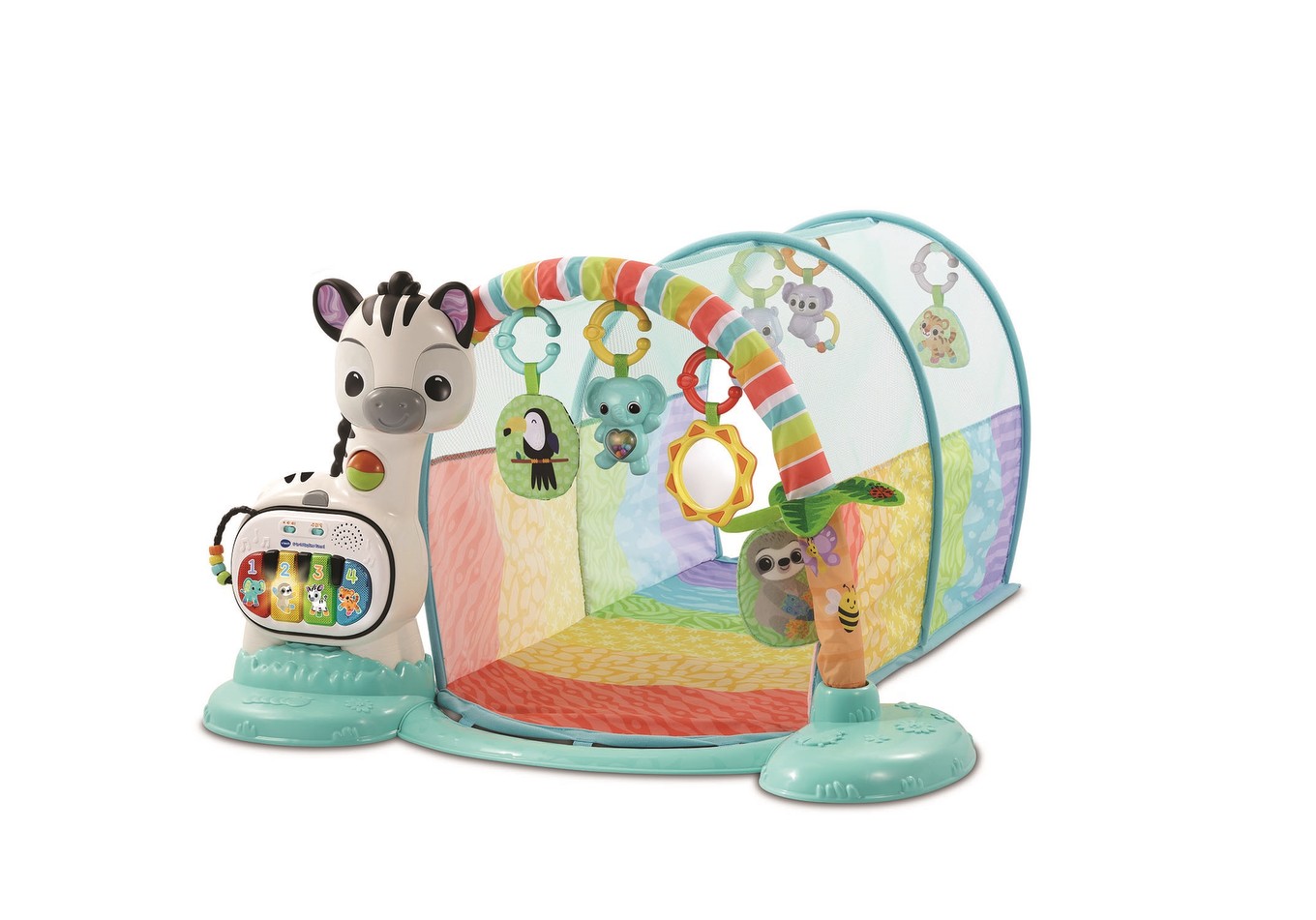
From tummy time to tunnel time, the 6-in-1 Tunnel of Fun keeps little ones engaged and encourages development through six stages of play.
Description
From tummy time to tunnel time, the 6-in-1 Tunnel of Fun keeps little ones engaged and encourages development through six stages of play. Laying under the arch, babies will love batting at the dangling toys and treating their eyes to a rainbow of colors and animals. Get a tummy-time workout on the soft mat while pressing the animal buttons on the light-up piano. Unclip the six sensory toys from the arch to attach to strollers and fit into diaper bags for kids to crinkle, rattle and spin on the go. Zebra can’t wait to play! Attach the piano to the zebra to help build baby’s core while they’re sitting. Ready for an adventure? Encourage crawling by clipping the sensory toys throughout the three foot tunnel. The piano’s three play modes with progressive levels encourage kids to play independently while building vocabulary about animals, numbers and colours. Playing in this tunnel is far from boring!

Recommended Products

This is a carousel. Use Next and Previous buttons to navigate. Or, jump to a slide by selecting one of the thumbnails.