This site uses cookies to store information on your computer.

Some of these cookies are essential, while others help us to improve your experience by providing insights into how the site is being used. For more detailed information on the cookies we use, please see our Cookie Policy.

Home
»
VTech Baby
»
Walk & Wag Puppy
9-36
MONTHS

This is a carousel. Use Next and Previous buttons to navigate. Or, jump to a slide by selecting one of the thumbnails.

Walk & Wag Puppy

Developmental Benefits

Motor Skills
Motor Skills
Role Play
Role Play
Imitative Play
Imitative Play
Imaginitive Play
Imaginitive Play

Developmental Benefits

Walk & Wag Puppy

Motor Skills
  • Encourages fine motor skill development.
  • An infant’s growth and development in the first year of life is rapid. Many movements that young babies make are in preparation for the next stage of their development. When young babies watch a mobile they are constantly moving their head, arms, legs and even their mouths in response to the movement of the toy. Sound and movement attract a baby’s attention; if a toy is placed almost within reach of babies their movements become more animated. Bath toys provide opportunities to develop and use motor skills to great effect. For example, a young baby has greater control over their leg movements than their arms. You will often see young babies in a bath reaching with their legs towards a floating toy and kicking. All these movements strengthen muscles in readiness for the next stage - walking.
    As babies develop they become more adept at grasping objects. Young infants learn to grasp an object, for instance a cube. The grasping, at first, is quite clumsy but through repetition, and across time, infants become adept at grasping and develop fine motor skills. Infants first use the ulnar grasp where their fingers close against the palm when trying to hold an object. Within another month they are able to move the object from hand to hand. After the first year, infants adopt the ‘pincer grasp’ where they use their thumb and index finger to grasp even very tiny objects. Shape sorters help infants to fine tune their visual perception and hand coordination. Soon infants are building towers with two cubes; this also requires fine coordination skills. As the child grows computer games have been shown to help with hand and eye coordination. Spatial skills can also be enhanced when playing games that require concentration, quick responses and finely tuned motor skills.
Role Play
  • Develops imagination and encourages cooperation, listening and turn-taking.
  • Role play is a form of social pretend play. Children benefit from social pretend play because it can help them to revisit events that may have provoked some anxiety in the past. For instance, after a visit to the doctors children often play at being doctors and nurses. Role play not only reflects but also contributes to children’s cognitive and social skills. Playing out an experience enables children to understand more about it.
    Research has shown that during social pretend play, young children’s interactions last longer, are more engaging and also more cooperative. Nursery school children who spend more time in socio-dramatic role playing are also perceived as more socially competent by their teachers. Role play enhances many cognitive abilities such as sustained attention, memory, language and literacy skills, and helps children to understand and manage their emotions. Role play is generally a social activity but some children can engage in solitary role play where they create imaginary companions. Games where children can create worlds and populate them with their own characters can be beneficial.
Imitative Play
  • Copying observed action encourages social and emotional skills.
  • Imitation begins very early in an infant’s life. Young children learn socially from older children and adults by copying them. Imitative play is a fundamental part of learning; young children watch adults and then copy them extensively. Throughout their early years children are learning to adapt to the cultural world into which they have been born. Imitative play allows children to experiment with the cultural tools and behaviour that they have observed. Children try to use laptops, phones and any other electronic device available to them because they have seen adults using and interacting with these devices. Young children’s manual dexterity and hand and eye coordination is well adapted for using mobile phones and other devices. Children can benefit from having replica items available, such as an infant laptop or an imitation mobile phone. These electronic items can enhance manual skills, hand and eye coordination and spatial skills.
    Imitative play requires children to observe and copy other’s behaviour. Sometimes children watch another child performing an action but don’t copy the action immediately. Lots of imitative play occurred in our nursery school study where we observed children playing with VTech toys. Children learn through observing and copying others. Young children watch other children and observe the consequences of actions without having to perform the actions themselves. This can help with social and also motor skills. A young child in our nursery study watched another child press a button on a toy to play some music and then jig up and down. After wandering off the young child who had observed the jigging returned to the toy pressed the button and began to jig up and down to the music. Children learn from each other as they play. Imitative play allows for lots of repetition which is also a valuable learning activity.
Imaginitive Play
  • Imagination and exploration through interaction with characters.
  • Children’s imagination is active from an early age. Imaginative play has links to what psychologists call ‘social pretend play’. Young children pretend or imagine that, for instance a wooden block is a cake and they carefully ‘cut’ it. A large proportion of pretend play tends to be social. Imaginative play begins when infants play and pretend with adults. As young children develop they begin to try to engage other children in social pretend play. Young children in nursery benefit from engaging in imaginative play. It helps them to begin to understand that other children think differently to them and have different ideas.
    Children can engage in imaginative play with other children where they have agreed on a story or scenario that they want to act out. Young children playing with toys use their imagination to invent scenarios and play out the consequences. They can use characters to explore scenarios and act out scripts such as going shopping or bedtime. Imaginative and social pretend play is beneficial for children as it allows them to explore different ways of viewing the world. Children who use their imagination when playing with other children are increasing their social competence and their understanding of other people. In a study where we observed children playing in a nursery we found that young children engaged in imaginative play, often using the toys in unexpected ways. Children’s imagination benefits from the opportunity to play with all types of toys.
Best for ages:
9 to 36 Months
Highlights
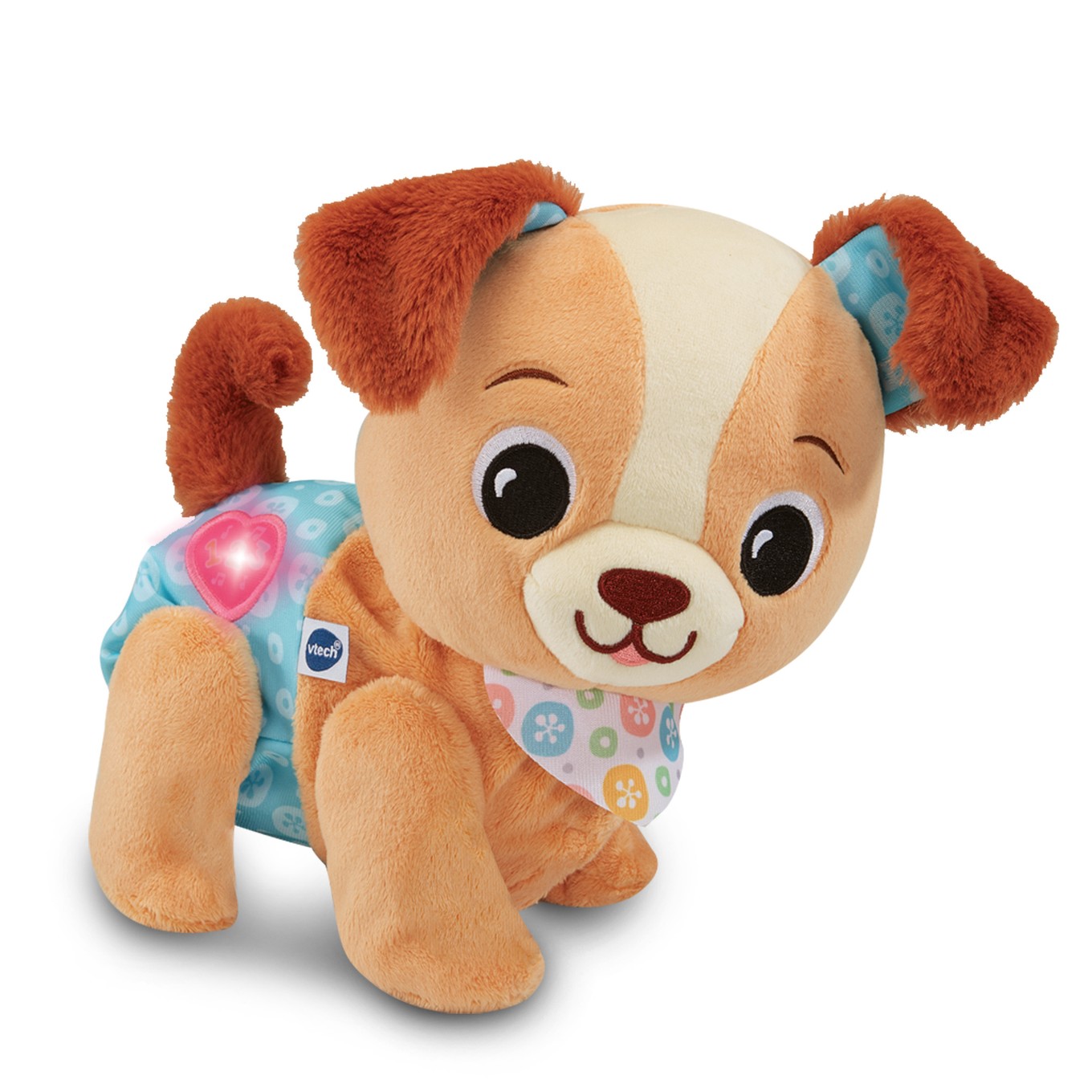
Press this soft puppy’s light up heart button to see it start walking, talking and using fun phrases and music to encourage little ones to follow!
Description
Let’s go on some wag-tastic adventures with the Walk & Wag Puppy. Cute, soft puppy is designed to get little ones moving! Press the light up heart button and puppy will start walking and talking, using fun phrases and music to encourage little ones to follow along! Keep pressing the button for more fun phrases, songs and tunes, encouraging little ones to nurture and care for Puppy as well as following along. Puppy’s wagging tail, soft fabric ears & tactile fur will delight little ones and encourage sensory awareness! Includes 3 fun sing-along songs and 15 upbeat melodies.

Recommended Products

This is a carousel. Use Next and Previous buttons to navigate. Or, jump to a slide by selecting one of the thumbnails.