This site uses cookies to store information on your computer.

Some of these cookies are essential, while others help us to improve your experience by providing insights into how the site is being used. For more detailed information on the cookies we use, please see our Cookie Policy.

Home
»
Others
»
Stitch Learning Phone
3-6
YEARS

This is a carousel. Use Next and Previous buttons to navigate. Or, jump to a slide by selecting one of the thumbnails.

Stitch Learning Phone

Developmental Benefits

Hand Eye Coordination
Motor Skills
Motor Skills
Problem Solving
Problem Solving

Developmental Benefits

Stitch Learning Phone

Hand Eye Coordination
  • Aiming and concentrating on a target improves hand/eye coordination.
  • Humans have highly developed manual dexterity skills that distinguish them from any other species on this planet. This manual dexterity emerges during the infant’s first year and, with plenty of opportunities to manipulate and play with toys and objects, becomes a highly tuned ability. Babies will reach and grasp for objects in an uncoordinated manner from an early age. As they begin to gain control over their movements infants succeed in reaching for and grasping toys. The first attempts by babies to grasp toys in their hands involve using the palm of their hand with all their fingers around the object. As development occurs through physical maturation and plenty of opportunities to play with toys, grasping becomes more sophisticated. The use of the opposable thumb and index finger allows infants to pick up very small objects in what is termed a ‘pincer grasp’. This finely tuned motor skill emerges at the end of first year of life.
    The development of hand and eye coordination skills continues throughout childhood where opportunities to play games that require children to manoeuvre objects, build tall towers or hit targets on a computer screen facilitate the development of finely-tuned hand and eye coordination.
Motor Skills
  • Encourages fine motor skill development.
  • An infant’s growth and development in the first year of life is rapid. Many movements that young babies make are in preparation for the next stage of their development. When young babies watch a mobile they are constantly moving their head, arms, legs and even their mouths in response to the movement of the toy. Sound and movement attract a baby’s attention; if a toy is placed almost within reach of babies their movements become more animated. Bath toys provide opportunities to develop and use motor skills to great effect. For example, a young baby has greater control over their leg movements than their arms. You will often see young babies in a bath reaching with their legs towards a floating toy and kicking. All these movements strengthen muscles in readiness for the next stage - walking.
    As babies develop they become more adept at grasping objects. Young infants learn to grasp an object, for instance a cube. The grasping, at first, is quite clumsy but through repetition, and across time, infants become adept at grasping and develop fine motor skills. Infants first use the ulnar grasp where their fingers close against the palm when trying to hold an object. Within another month they are able to move the object from hand to hand. After the first year, infants adopt the ‘pincer grasp’ where they use their thumb and index finger to grasp even very tiny objects. Shape sorters help infants to fine tune their visual perception and hand coordination. Soon infants are building towers with two cubes; this also requires fine coordination skills. As the child grows computer games have been shown to help with hand and eye coordination. Spatial skills can also be enhanced when playing games that require concentration, quick responses and finely tuned motor skills.
Problem Solving
  • Develops logic skills and strategic thinking through memory.
  • Babies become increasingly adept at solving problems as their motor skills become more finely tuned. Problem solving in infancy and childhood is about directing attention towards a goal and behaving in such a way as to achieve a successful outcome. For instance, a young infant who sees an adult hide a toy under a blanket will cease to look for it whereas an older infant will pull away the blanket to reveal the toy. These types of actions are the foundations of problem solving behaviour. Babies and children love games where they have to find a hidden object; they can have fun and at the same time increase their problem solving capabilities.
    Babies love to explore and experiment with the world. At the end of the first year infants are exploring the features of objects by handling and playing with them in new ways. For instance, when babies are trying to fit a block through a hole they will twist, turn and push it until it fits through the space. Babies are also expanding their problem solving skills by learning to look for objects in more than one place. Adults can help with the development of problem solving in young children by directing attention to the potential solution to a problem. As children grow they learn to direct their attention and plan their actions. Thinking about actions ahead of time and planning what do next is all part of problem solving. Playing games, whether it is on a computer or with another person can enhance problem solving skills.
Best for ages:
3 to 6 Years
Highlights
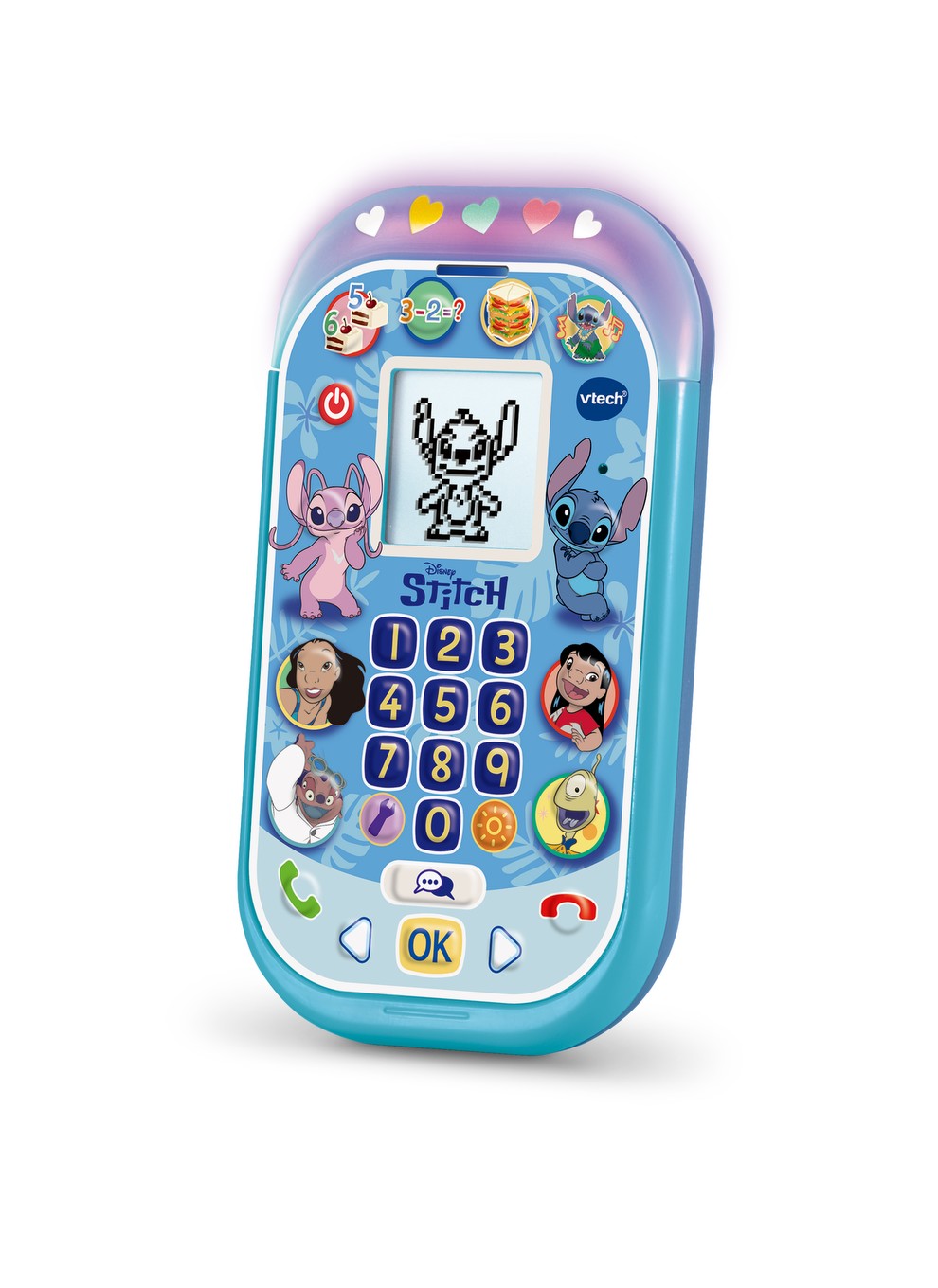
Press the 6 character buttons to play fun mini games, make virtual calls and play 4 learning games with Stitch and his friends.
Description
Join Stitch and friends on a Hawaiian island adventure! Make virtual calls to your favourite characters using voice activation play, role-play phone calls and leave messages! Press the 6 character buttons to play fun mini games with each of them. 4 learning games include teaching Stitch how to hula dance by matching poses to the rhythm, helping Lilo teach Stitch how to work out sums, helping Stitch make sandwiches by finding the correct filling or practising odd and even numbers by counting Stitch’s cupcakes! Backlit screen and colour-changing light bar enhance the play experience and customisable settings enhance role-play fun. Phone introduces maths, matching, memory skills and more.

Recommended Products

This is a carousel. Use Next and Previous buttons to navigate. Or, jump to a slide by selecting one of the thumbnails.