This site uses cookies to store information on your computer.

Some of these cookies are essential, while others help us to improve your experience by providing insights into how the site is being used. For more detailed information on the cookies we use, please see our Cookie Policy.

Home
»
Others
»
Gabby's Dollhouse: Cat-a-Vator Discovery Book
3-6
YEARS

This is a carousel. Use Next and Previous buttons to navigate. Or, jump to a slide by selecting one of the thumbnails.

Gabby's Dollhouse: Cat-a-Vator Discovery Book

Developmental Benefits

Basic Maths Skills
Basic Maths Skills
Cooperative Play
Cooperative Play
Musical Creativity
Musical Creativity

Developmental Benefits

Gabby's Dollhouse: Cat-a-Vator Discovery Book

Basic Maths Skills
  • Develops counting and number identification.
  • Even young babies can discriminate between a small set of objects and a large set of objects. Young children learn to match their culture’s number words and symbols (e.g. 1, 2, and 3) to specific quantities. Research has shown that maths skills can improve with practice; young children who are given plenty of opportunity to work and play with numbers and counting will improve their basic maths skills. Counting rhymes are very popular with babies and young children and teach them basic maths concepts in a fun way. A young child may make mistakes when learning to count (e.g. missing out the number 6 when counting 10 bricks). But this young child is still demonstrating the basic maths ability; linking number words to actual numbers, realising that each item can only have one number word, and that the numbers have a sequence. Number games, learning about sequences and singing counting rhymes all help to enhance children’s basic maths skills.
    Repetition is also important, for instance, singing counting rhymes over and over again gets babies used to number words and their sequence. Toys that count as babies, for instance, place bricks in a slot and computer games that present children with fun maths problems are also useful learning tools. Play and practice with numbers is fun for babies and is essential for the development of young children’s understanding of quantity.
Cooperative Play
  • Encourages social skills like sharing and teamwork
  • Many toys offer the opportunity for infants and children to play cooperatively. An example of early cooperative play is when a child hands a brick to another child who is building a tower. More complex types of cooperative play, such as social pretend play where children adopt roles, often occurs between two children who are friends. But cooperative play can happen between children who have never met before. This type of cooperative play can often be observed at the Baby Show where a number of infants and young children play cooperatively together with toys on the VTech stand. Young children’s cooperative and social skills are monitored by adults; parents, nursery assistants and teachers encourage cooperative play as it enhances social skills such as caring, sharing, helping and working together. Sometimes young children want to control a toy and don’t want to let other children play. At this point children benefit from an adult’s intervention and encouragement to share.
    Cooperative play means that children are working towards a shared goal whether this is building a tower or engaging in social pretend play. Toys and games can facilitate cooperative play and fun activities become more engaging when more than one child is playing. Cooperative play benefits young children as it prepares them for cooperative learning in the classroom. There is a strong emphasis on children working together during lessons to achieve shared goals.
Musical Creativity
  • Enhances musical skills with music and sound activities.
  • Babies are sensitive to sound patterns early in life and respond emotionally to voices. Even before they are born infants detect and monitor sound to a certain extent. During the second half of their first year babies are particularly sensitive to differences in beat and rhythm. Music is a complex form of auditory stimulation that is linked to human movement. Infants are drawn to music and are very good at being able to discern different musical structures. In a recent survey we found that parents often choose a particular traditional nursery, for example twinkle, twinkle little star, because of the gestures linked to the song. Babies love music and nursery rhymes that have plenty of repetition and gestures.
    Children also love to experiment with music. Toys that allow children to create their own tunes facilitate learning. Children can learn about a wide variety of sounds and tempo. They can also learn about the sounds of different musical instruments through pressing keys on a musical toy. Children who grow up in the Western world tend to be exposed to the typical even-beat pattern of Western music. There is a link between learning, singing and rhythm that is related to the type of culture that children grow up in. Musical creativity can be nurtured through the infant’s and child’s exposure to music, musical toys and instruments.
Best for ages:
3 to 6 Years
Highlights
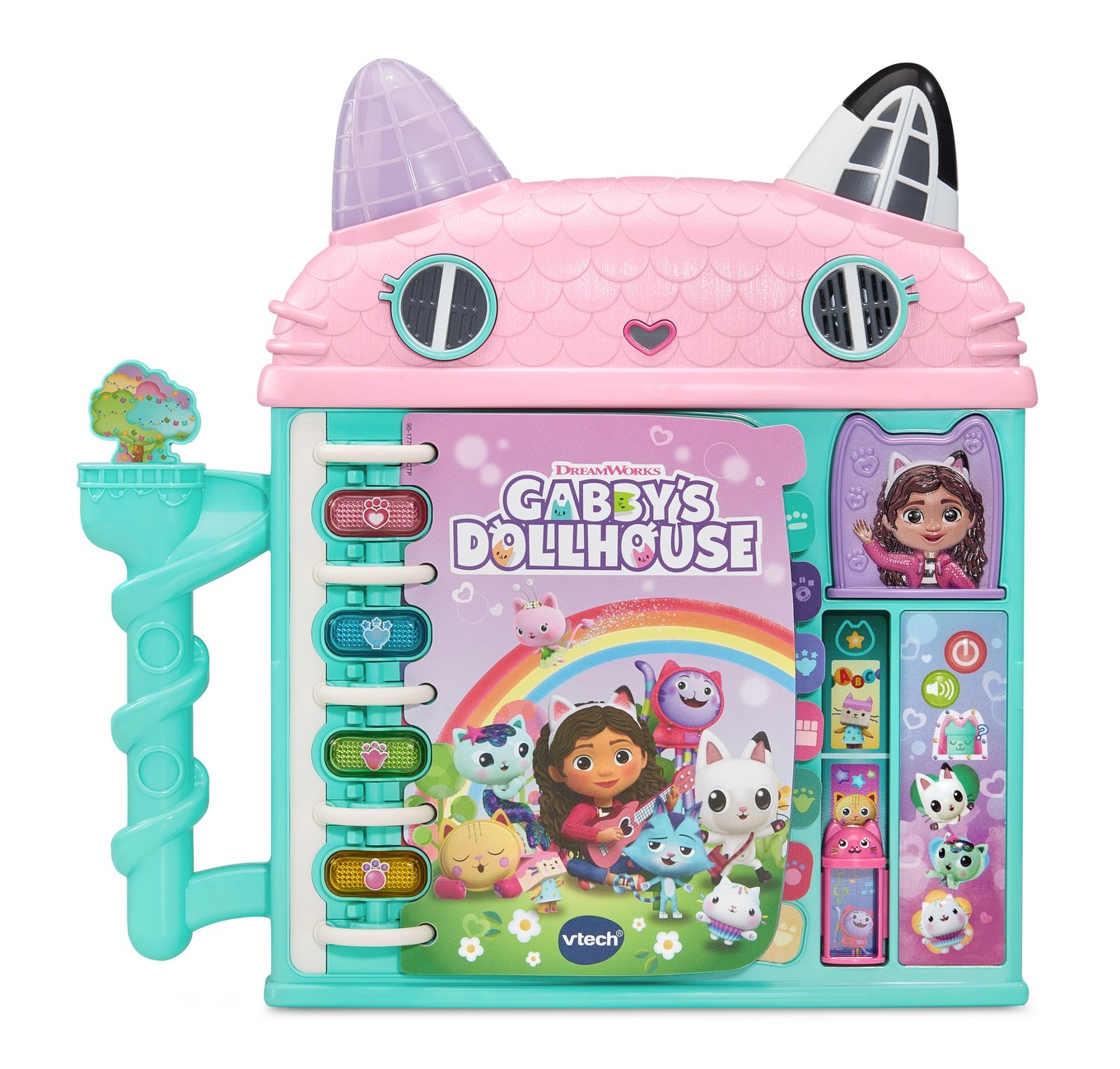
The Cat-a-Vator Discovery Book includes 14 interactive book pages! Includes an activity Slider for three activity modes to explore the Dollhouse with Gabby and friends.
Description
This paw-tastic Cat-a-Vator Discovery Book includes 14 interactive book pages to engage with! Move the Cat-A-Vator Mode Slider to access the three activity modes and explore the Dollhouse with Gabby and friends. Your child can learn about the 28 Dollhouse words and jam to cute sounds with DJ Catnip’s music. Press the Surprise Box Button to take on challenges and help Gabby solve questions on each page by pressing the 4 Light Up Buttons. Press the Gabby Button and the buttons for the Gabby Cats to hear adorable show phrases with Gabby’s signature excitement and to learn more about them. Let’s have a meow-zing party time with Gabby and the Gabby Cats!

Recommended Products

This is a carousel. Use Next and Previous buttons to navigate. Or, jump to a slide by selecting one of the thumbnails.