This site uses cookies to store information on your computer.

Some of these cookies are essential, while others help us to improve your experience by providing insights into how the site is being used. For more detailed information on the cookies we use, please see our Cookie Policy.

Home
»
Others
»
PAW Patrol Rescue Mission Learning Phone
3-6
YEARS

This is a carousel. Use Next and Previous buttons to navigate. Or, jump to a slide by selecting one of the thumbnails.

PAW Patrol Rescue Mission Learning Phone

Developmental Benefits

Auditory Stimulation
Basic Maths Skills
Basic Maths Skills
Imaginitive Play
Imaginitive Play
Problem Solving
Problem Solving
Visualisation Memory

Developmental Benefits

PAW Patrol Rescue Mission Learning Phone

Auditory Stimulation
  • Fun and interesting sound effects draw baby’s attention to play.
  • Even very early in life babies can hear a wide variety of sounds. Infants will turn towards the sound of a toy and begin to reach towards it. This ability to recognise the direction that a sound is coming from improves greatly during the first few years of life. Young infants listen longer to the sound of human voice and seem to prefer it to any other sound. They are especially aware of the sound of language and like to be spoken to slowly and with a high pitch. This is sometimes referred to as ‘infant directed speech’ or even ‘baby talk’. Young babies are quite sensitive in their auditory abilities and can perceive all the categorical sound distinctions in world languages. As babies develop their auditory abilities narrow so that eventually babies are only sensitive to those sound categories specific to their native language.
    As soon as babies are born they are influenced by what they hear around them and modify what they able to hear, accordingly. At the same time they become increasingly sensitive to music and musical patterns. Even in their first year babies are distinguishing between musical tunes on the basis of rhythmic patterns and later they begin to recognise the same melody played in a different key. Giving babies plenty of opportunities to hear music, singing, rhythm and talk enhances their learning and prepares them for the social world where they will talk, sing, play and listen to music.
Basic Maths Skills
  • Develops counting and number identification.
  • Even young babies can discriminate between a small set of objects and a large set of objects. Young children learn to match their culture’s number words and symbols (e.g. 1, 2, and 3) to specific quantities. Research has shown that maths skills can improve with practice; young children who are given plenty of opportunity to work and play with numbers and counting will improve their basic maths skills. Counting rhymes are very popular with babies and young children and teach them basic maths concepts in a fun way. A young child may make mistakes when learning to count (e.g. missing out the number 6 when counting 10 bricks). But this young child is still demonstrating the basic maths ability; linking number words to actual numbers, realising that each item can only have one number word, and that the numbers have a sequence. Number games, learning about sequences and singing counting rhymes all help to enhance children’s basic maths skills.
    Repetition is also important, for instance, singing counting rhymes over and over again gets babies used to number words and their sequence. Toys that count as babies, for instance, place bricks in a slot and computer games that present children with fun maths problems are also useful learning tools. Play and practice with numbers is fun for babies and is essential for the development of young children’s understanding of quantity.
Imaginitive Play
  • Imagination and exploration through interaction with characters.
  • Children’s imagination is active from an early age. Imaginative play has links to what psychologists call ‘social pretend play’. Young children pretend or imagine that, for instance a wooden block is a cake and they carefully ‘cut’ it. A large proportion of pretend play tends to be social. Imaginative play begins when infants play and pretend with adults. As young children develop they begin to try to engage other children in social pretend play. Young children in nursery benefit from engaging in imaginative play. It helps them to begin to understand that other children think differently to them and have different ideas.
    Children can engage in imaginative play with other children where they have agreed on a story or scenario that they want to act out. Young children playing with toys use their imagination to invent scenarios and play out the consequences. They can use characters to explore scenarios and act out scripts such as going shopping or bedtime. Imaginative and social pretend play is beneficial for children as it allows them to explore different ways of viewing the world. Children who use their imagination when playing with other children are increasing their social competence and their understanding of other people. In a study where we observed children playing in a nursery we found that young children engaged in imaginative play, often using the toys in unexpected ways. Children’s imagination benefits from the opportunity to play with all types of toys.
Problem Solving
  • Develops logic skills and strategic thinking through memory.
  • Babies become increasingly adept at solving problems as their motor skills become more finely tuned. Problem solving in infancy and childhood is about directing attention towards a goal and behaving in such a way as to achieve a successful outcome. For instance, a young infant who sees an adult hide a toy under a blanket will cease to look for it whereas an older infant will pull away the blanket to reveal the toy. These types of actions are the foundations of problem solving behaviour. Babies and children love games where they have to find a hidden object; they can have fun and at the same time increase their problem solving capabilities.
    Babies love to explore and experiment with the world. At the end of the first year infants are exploring the features of objects by handling and playing with them in new ways. For instance, when babies are trying to fit a block through a hole they will twist, turn and push it until it fits through the space. Babies are also expanding their problem solving skills by learning to look for objects in more than one place. Adults can help with the development of problem solving in young children by directing attention to the potential solution to a problem. As children grow they learn to direct their attention and plan their actions. Thinking about actions ahead of time and planning what do next is all part of problem solving. Playing games, whether it is on a computer or with another person can enhance problem solving skills.
Visualisation Memory
  • Engaging graphics & visualisation activities develop memory.
  • As babies develop they begin to use mental pictures of objects that are no longer within their field of vision. These memory skills can be enhanced through presenting visual stimuli more than once; repetition is essential for the development of memory skills. Young infants’ memories are influenced by context; for instance, they can imitate an adult’s actions with a toy but only if the toy is identical in colour and features to the one that the adult played with. Older infants can remember, for instance, how to press a toy animal to make a sound even if the toy is slightly different to the one which the adult used to demonstrate. Infants’ memories become less context dependent at the same time that infants start to crawl and walk. Giving babies plenty of opportunity to explore their world allows them to enhance their memory skills.
    As children’s attention span increases so do their memory strategies. This means that children can use deliberate mental activities, such as visualisation, to increase the chances of retaining information in working memory and then shifting it to their long-term knowledge base. Lots of rehearsal and organisation is needed to use memory to its full advantage; repetition is an important part of both infant and childhood learning. Children can both learn and practice memory strategies using toys and games. Toys that encourage children to remember visual stimuli, answer questions and then repeat the activity over again enhance learning.
Best for ages:
3 to 6 Years
Highlights
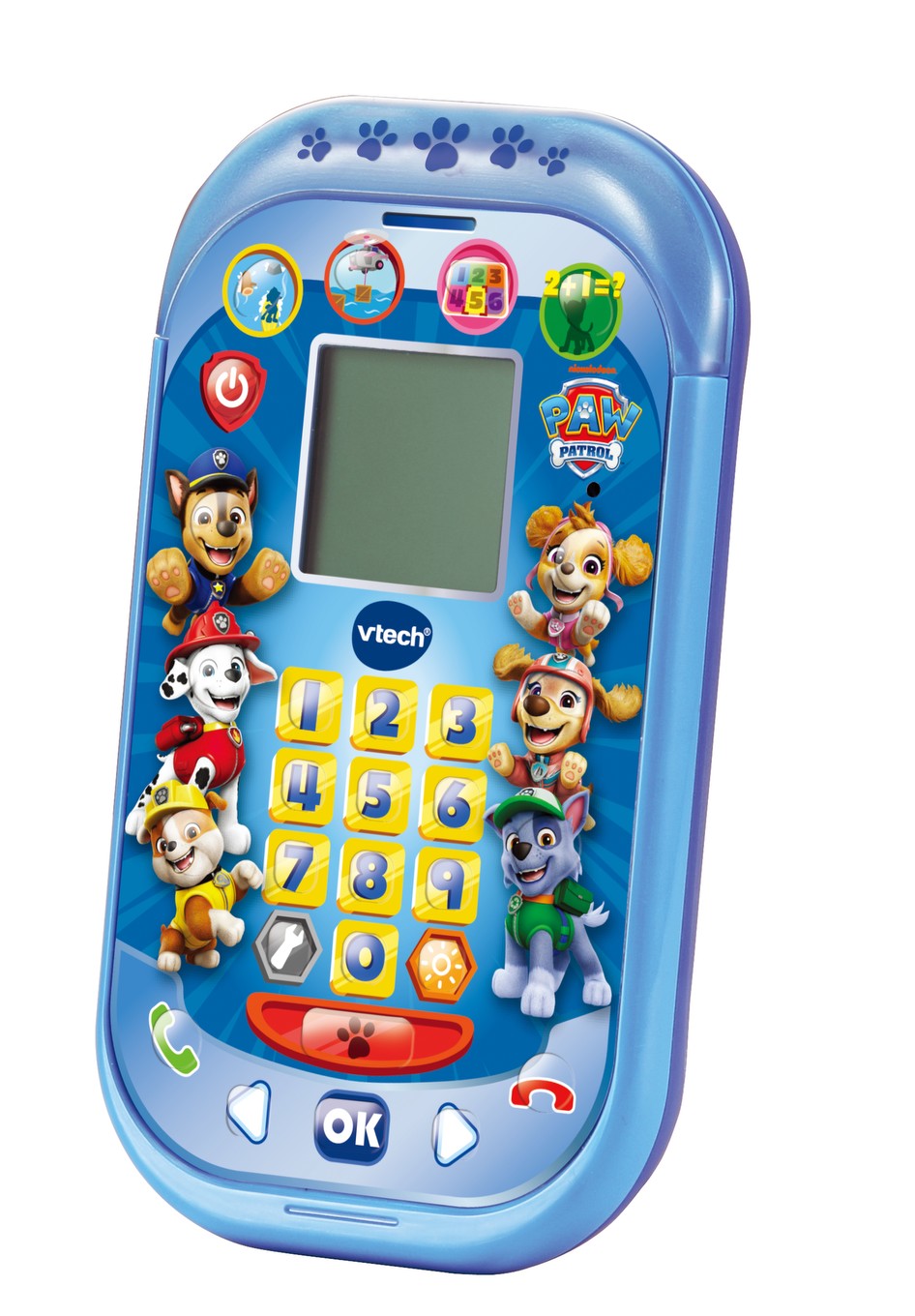
Answer the call of Adventure Bay! Call Marshall, Chase, Skye, Liberty, Rubble and Rocky and pretend to leave messages for them.
Description
Answer the call of Adventure Bay! Call Marshall, Chase, Skye, Liberty, Rubble and Rocky and pretend to leave messages for them. Play four exciting activities and help Marshall avoid obstacles, pick up shape boxes with Skye, remember dance steps with Liberty or help Chase recover gold by solving simple equations. Team up with Ryder to choose the best pup for the job on six Pup Pup Missions. Choose from five ringtones to make the phone feel unique.

Recommended Products

This is a carousel. Use Next and Previous buttons to navigate. Or, jump to a slide by selecting one of the thumbnails.