This site uses cookies to store information on your computer.

Some of these cookies are essential, while others help us to improve your experience by providing insights into how the site is being used. For more detailed information on the cookies we use, please see our Cookie Policy.

Home
»
Others
»
Jamming Tunes Guitar
2-4
YEARS

This is a carousel. Use Next and Previous buttons to navigate. Or, jump to a slide by selecting one of the thumbnails.

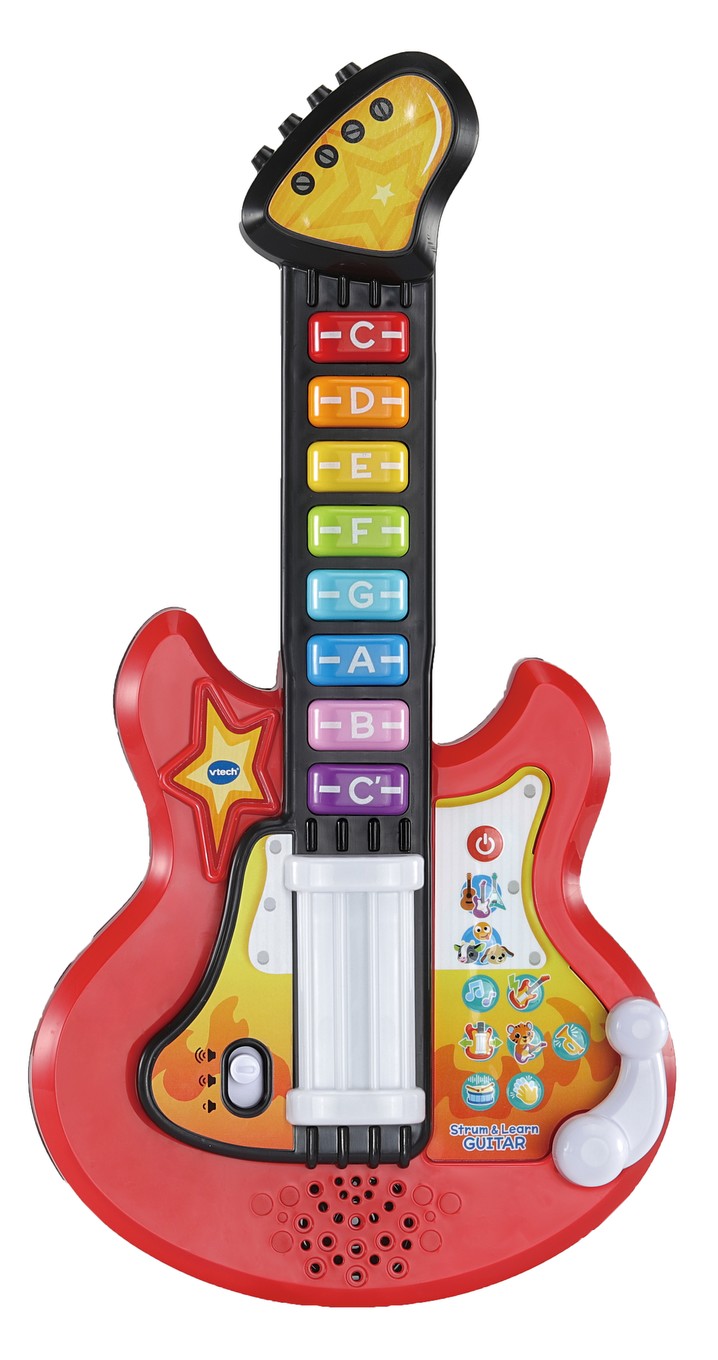
Jamming Tunes Guitar

Developmental Benefits

Auditory Stimulation
Motor Skills
Motor Skills
Musical Creativity
Musical Creativity
Role Play
Role Play

Developmental Benefits

Jamming Tunes Guitar

Auditory Stimulation
  • Fun and interesting sound effects draw baby’s attention to play.
  • Even very early in life babies can hear a wide variety of sounds. Infants will turn towards the sound of a toy and begin to reach towards it. This ability to recognise the direction that a sound is coming from improves greatly during the first few years of life. Young infants listen longer to the sound of human voice and seem to prefer it to any other sound. They are especially aware of the sound of language and like to be spoken to slowly and with a high pitch. This is sometimes referred to as ‘infant directed speech’ or even ‘baby talk’. Young babies are quite sensitive in their auditory abilities and can perceive all the categorical sound distinctions in world languages. As babies develop their auditory abilities narrow so that eventually babies are only sensitive to those sound categories specific to their native language.
    As soon as babies are born they are influenced by what they hear around them and modify what they able to hear, accordingly. At the same time they become increasingly sensitive to music and musical patterns. Even in their first year babies are distinguishing between musical tunes on the basis of rhythmic patterns and later they begin to recognise the same melody played in a different key. Giving babies plenty of opportunities to hear music, singing, rhythm and talk enhances their learning and prepares them for the social world where they will talk, sing, play and listen to music.
Motor Skills
  • Encourages fine motor skill development.
  • An infant’s growth and development in the first year of life is rapid. Many movements that young babies make are in preparation for the next stage of their development. When young babies watch a mobile they are constantly moving their head, arms, legs and even their mouths in response to the movement of the toy. Sound and movement attract a baby’s attention; if a toy is placed almost within reach of babies their movements become more animated. Bath toys provide opportunities to develop and use motor skills to great effect. For example, a young baby has greater control over their leg movements than their arms. You will often see young babies in a bath reaching with their legs towards a floating toy and kicking. All these movements strengthen muscles in readiness for the next stage - walking.
    As babies develop they become more adept at grasping objects. Young infants learn to grasp an object, for instance a cube. The grasping, at first, is quite clumsy but through repetition, and across time, infants become adept at grasping and develop fine motor skills. Infants first use the ulnar grasp where their fingers close against the palm when trying to hold an object. Within another month they are able to move the object from hand to hand. After the first year, infants adopt the ‘pincer grasp’ where they use their thumb and index finger to grasp even very tiny objects. Shape sorters help infants to fine tune their visual perception and hand coordination. Soon infants are building towers with two cubes; this also requires fine coordination skills. As the child grows computer games have been shown to help with hand and eye coordination. Spatial skills can also be enhanced when playing games that require concentration, quick responses and finely tuned motor skills.
Musical Creativity
  • Enhances musical skills with music and sound activities.
  • Babies are sensitive to sound patterns early in life and respond emotionally to voices. Even before they are born infants detect and monitor sound to a certain extent. During the second half of their first year babies are particularly sensitive to differences in beat and rhythm. Music is a complex form of auditory stimulation that is linked to human movement. Infants are drawn to music and are very good at being able to discern different musical structures. In a recent survey we found that parents often choose a particular traditional nursery, for example twinkle, twinkle little star, because of the gestures linked to the song. Babies love music and nursery rhymes that have plenty of repetition and gestures.
    Children also love to experiment with music. Toys that allow children to create their own tunes facilitate learning. Children can learn about a wide variety of sounds and tempo. They can also learn about the sounds of different musical instruments through pressing keys on a musical toy. Children who grow up in the Western world tend to be exposed to the typical even-beat pattern of Western music. There is a link between learning, singing and rhythm that is related to the type of culture that children grow up in. Musical creativity can be nurtured through the infant’s and child’s exposure to music, musical toys and instruments.
Role Play
  • Develops imagination and encourages cooperation, listening and turn-taking.
  • Role play is a form of social pretend play. Children benefit from social pretend play because it can help them to revisit events that may have provoked some anxiety in the past. For instance, after a visit to the doctors children often play at being doctors and nurses. Role play not only reflects but also contributes to children’s cognitive and social skills. Playing out an experience enables children to understand more about it.
    Research has shown that during social pretend play, young children’s interactions last longer, are more engaging and also more cooperative. Nursery school children who spend more time in socio-dramatic role playing are also perceived as more socially competent by their teachers. Role play enhances many cognitive abilities such as sustained attention, memory, language and literacy skills, and helps children to understand and manage their emotions. Role play is generally a social activity but some children can engage in solitary role play where they create imaginary companions. Games where children can create worlds and populate them with their own characters can be beneficial.
Best for ages:
2 to 4 Years
Highlights
Rock & roll your way to creative play! Explore making music, singing along and sharing your new skills with your adoring fans.
Description
Rock & roll your way to creative play! The more rainbow buttons you press, the more sounds you hear. Move the strings to make your own music or jam along to the built-in melodies. Explore nine different sound styles including electric guitar, animal sounds, silly sounds and more. Bathe in the applause as you build fine motor skills. Adjust the volume for quieter play. Make music, sing along and share your new skills with your adoring fans. Intended for ages 1.5-4 years. Requires 2 AA batteries. Batteries included for demo purposes only. New batteries recommended for regular use.

Recommended Products

This is a carousel. Use Next and Previous buttons to navigate. Or, jump to a slide by selecting one of the thumbnails.