This site uses cookies to store information on your computer.

Some of these cookies are essential, while others help us to improve your experience by providing insights into how the site is being used. For more detailed information on the cookies we use, please see our Cookie Policy.

Home
»
Others
»
Trotting Tunes Hobby Horse
2+
YEARS

This is a carousel. Use Next and Previous buttons to navigate. Or, jump to a slide by selecting one of the thumbnails.

Trotting Tunes Hobby Horse

Developmental Benefits

Imitative Play
Imitative Play
Motor Skills
Motor Skills
Musical Creativity
Musical Creativity

Developmental Benefits

Trotting Tunes Hobby Horse

Imitative Play
  • Copying observed action encourages social and emotional skills.
  • Imitation begins very early in an infant’s life. Young children learn socially from older children and adults by copying them. Imitative play is a fundamental part of learning; young children watch adults and then copy them extensively. Throughout their early years children are learning to adapt to the cultural world into which they have been born. Imitative play allows children to experiment with the cultural tools and behaviour that they have observed. Children try to use laptops, phones and any other electronic device available to them because they have seen adults using and interacting with these devices. Young children’s manual dexterity and hand and eye coordination is well adapted for using mobile phones and other devices. Children can benefit from having replica items available, such as an infant laptop or an imitation mobile phone. These electronic items can enhance manual skills, hand and eye coordination and spatial skills.
    Imitative play requires children to observe and copy other’s behaviour. Sometimes children watch another child performing an action but don’t copy the action immediately. Lots of imitative play occurred in our nursery school study where we observed children playing with VTech toys. Children learn through observing and copying others. Young children watch other children and observe the consequences of actions without having to perform the actions themselves. This can help with social and also motor skills. A young child in our nursery study watched another child press a button on a toy to play some music and then jig up and down. After wandering off the young child who had observed the jigging returned to the toy pressed the button and began to jig up and down to the music. Children learn from each other as they play. Imitative play allows for lots of repetition which is also a valuable learning activity.
Motor Skills
  • Encourages fine motor skill development.
  • An infant’s growth and development in the first year of life is rapid. Many movements that young babies make are in preparation for the next stage of their development. When young babies watch a mobile they are constantly moving their head, arms, legs and even their mouths in response to the movement of the toy. Sound and movement attract a baby’s attention; if a toy is placed almost within reach of babies their movements become more animated. Bath toys provide opportunities to develop and use motor skills to great effect. For example, a young baby has greater control over their leg movements than their arms. You will often see young babies in a bath reaching with their legs towards a floating toy and kicking. All these movements strengthen muscles in readiness for the next stage - walking.
    As babies develop they become more adept at grasping objects. Young infants learn to grasp an object, for instance a cube. The grasping, at first, is quite clumsy but through repetition, and across time, infants become adept at grasping and develop fine motor skills. Infants first use the ulnar grasp where their fingers close against the palm when trying to hold an object. Within another month they are able to move the object from hand to hand. After the first year, infants adopt the ‘pincer grasp’ where they use their thumb and index finger to grasp even very tiny objects. Shape sorters help infants to fine tune their visual perception and hand coordination. Soon infants are building towers with two cubes; this also requires fine coordination skills. As the child grows computer games have been shown to help with hand and eye coordination. Spatial skills can also be enhanced when playing games that require concentration, quick responses and finely tuned motor skills.
Musical Creativity
  • Enhances musical skills with music and sound activities.
  • Babies are sensitive to sound patterns early in life and respond emotionally to voices. Even before they are born infants detect and monitor sound to a certain extent. During the second half of their first year babies are particularly sensitive to differences in beat and rhythm. Music is a complex form of auditory stimulation that is linked to human movement. Infants are drawn to music and are very good at being able to discern different musical structures. In a recent survey we found that parents often choose a particular traditional nursery, for example twinkle, twinkle little star, because of the gestures linked to the song. Babies love music and nursery rhymes that have plenty of repetition and gestures.
    Children also love to experiment with music. Toys that allow children to create their own tunes facilitate learning. Children can learn about a wide variety of sounds and tempo. They can also learn about the sounds of different musical instruments through pressing keys on a musical toy. Children who grow up in the Western world tend to be exposed to the typical even-beat pattern of Western music. There is a link between learning, singing and rhythm that is related to the type of culture that children grow up in. Musical creativity can be nurtured through the infant’s and child’s exposure to music, musical toys and instruments.
Best for ages:
2+ Years
Highlights
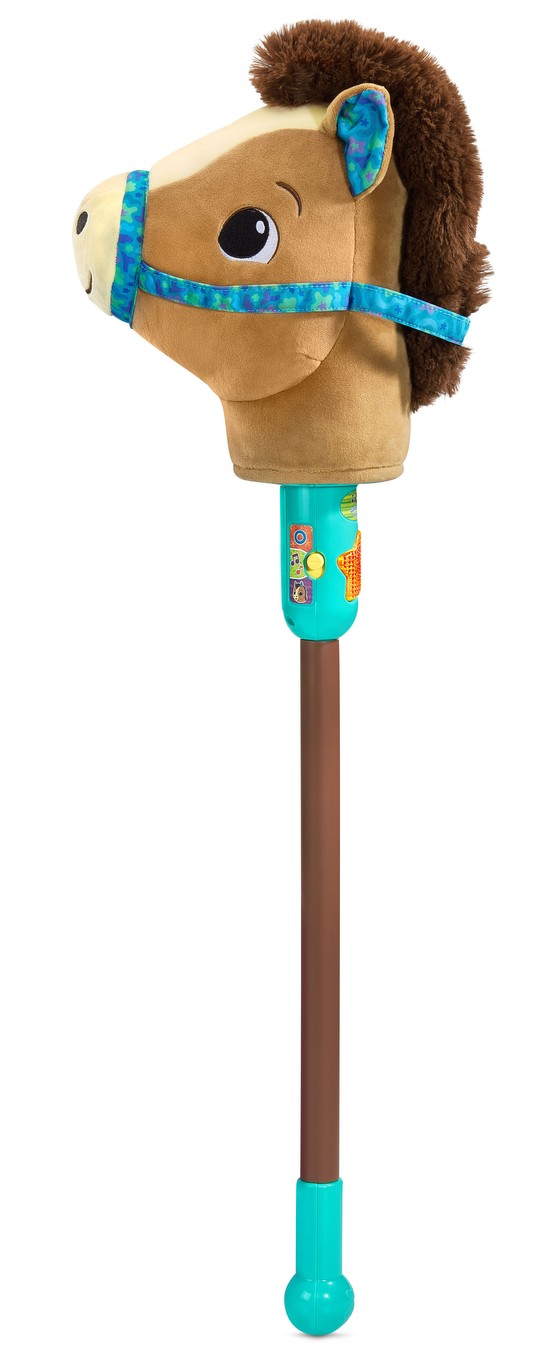
Saddle up and ride this adorable hobby horse with motion sensor that activates music and changes the tempo based on how fast kids go.
Description
Saddle up and go for a ride on this adorable hobby horse. Rock and ride to Music and Learning modes that play songs and introduce facts about the friendly horse. Change the pace and the music tempo too! Walk the horse around to play the songs slowly or giddy up and gallop to play the music faster. Press the light-up star to hear pretend-play phrases and to change the music. Let’s go! This 76 cm horse is easy to assemble. Connect the horse to the riding stick with a click and trot off into the sunset.

Recommended Products

This is a carousel. Use Next and Previous buttons to navigate. Or, jump to a slide by selecting one of the thumbnails.