This site uses cookies to store information on your computer.

Some of these cookies are essential, while others help us to improve your experience by providing insights into how the site is being used. For more detailed information on the cookies we use, please see our Cookie Policy.

Home
»
Others
»
PAW Patrol Everest Watch
3-6
YEARS

This is a carousel. Use Next and Previous buttons to navigate. Or, jump to a slide by selecting one of the thumbnails.

PAW Patrol Everest Watch

Developmental Benefits

Basic Maths Skills
Basic Maths Skills
Hand Eye Coordination
Visualisation Memory

Developmental Benefits

PAW Patrol Everest Watch

Basic Maths Skills
  • Develops counting and number identification.
  • Even young babies can discriminate between a small set of objects and a large set of objects. Young children learn to match their culture’s number words and symbols (e.g. 1, 2, and 3) to specific quantities. Research has shown that maths skills can improve with practice; young children who are given plenty of opportunity to work and play with numbers and counting will improve their basic maths skills. Counting rhymes are very popular with babies and young children and teach them basic maths concepts in a fun way. A young child may make mistakes when learning to count (e.g. missing out the number 6 when counting 10 bricks). But this young child is still demonstrating the basic maths ability; linking number words to actual numbers, realising that each item can only have one number word, and that the numbers have a sequence. Number games, learning about sequences and singing counting rhymes all help to enhance children’s basic maths skills.
    Repetition is also important, for instance, singing counting rhymes over and over again gets babies used to number words and their sequence. Toys that count as babies, for instance, place bricks in a slot and computer games that present children with fun maths problems are also useful learning tools. Play and practice with numbers is fun for babies and is essential for the development of young children’s understanding of quantity.
Hand Eye Coordination
  • Aiming and concentrating on a target improves hand/eye coordination.
  • Humans have highly developed manual dexterity skills that distinguish them from any other species on this planet. This manual dexterity emerges during the infant’s first year and, with plenty of opportunities to manipulate and play with toys and objects, becomes a highly tuned ability. Babies will reach and grasp for objects in an uncoordinated manner from an early age. As they begin to gain control over their movements infants succeed in reaching for and grasping toys. The first attempts by babies to grasp toys in their hands involve using the palm of their hand with all their fingers around the object. As development occurs through physical maturation and plenty of opportunities to play with toys, grasping becomes more sophisticated. The use of the opposable thumb and index finger allows infants to pick up very small objects in what is termed a ‘pincer grasp’. This finely tuned motor skill emerges at the end of first year of life.
    The development of hand and eye coordination skills continues throughout childhood where opportunities to play games that require children to manoeuvre objects, build tall towers or hit targets on a computer screen facilitate the development of finely-tuned hand and eye coordination.
Visualisation Memory
  • Engaging graphics & visualisation activities develop memory.
  • As babies develop they begin to use mental pictures of objects that are no longer within their field of vision. These memory skills can be enhanced through presenting visual stimuli more than once; repetition is essential for the development of memory skills. Young infants’ memories are influenced by context; for instance, they can imitate an adult’s actions with a toy but only if the toy is identical in colour and features to the one that the adult played with. Older infants can remember, for instance, how to press a toy animal to make a sound even if the toy is slightly different to the one which the adult used to demonstrate. Infants’ memories become less context dependent at the same time that infants start to crawl and walk. Giving babies plenty of opportunity to explore their world allows them to enhance their memory skills.
    As children’s attention span increases so do their memory strategies. This means that children can use deliberate mental activities, such as visualisation, to increase the chances of retaining information in working memory and then shifting it to their long-term knowledge base. Lots of rehearsal and organisation is needed to use memory to its full advantage; repetition is an important part of both infant and childhood learning. Children can both learn and practice memory strategies using toys and games. Toys that encourage children to remember visual stimuli, answer questions and then repeat the activity over again enhance learning.
Best for ages:
3 to 6 Years
Highlights
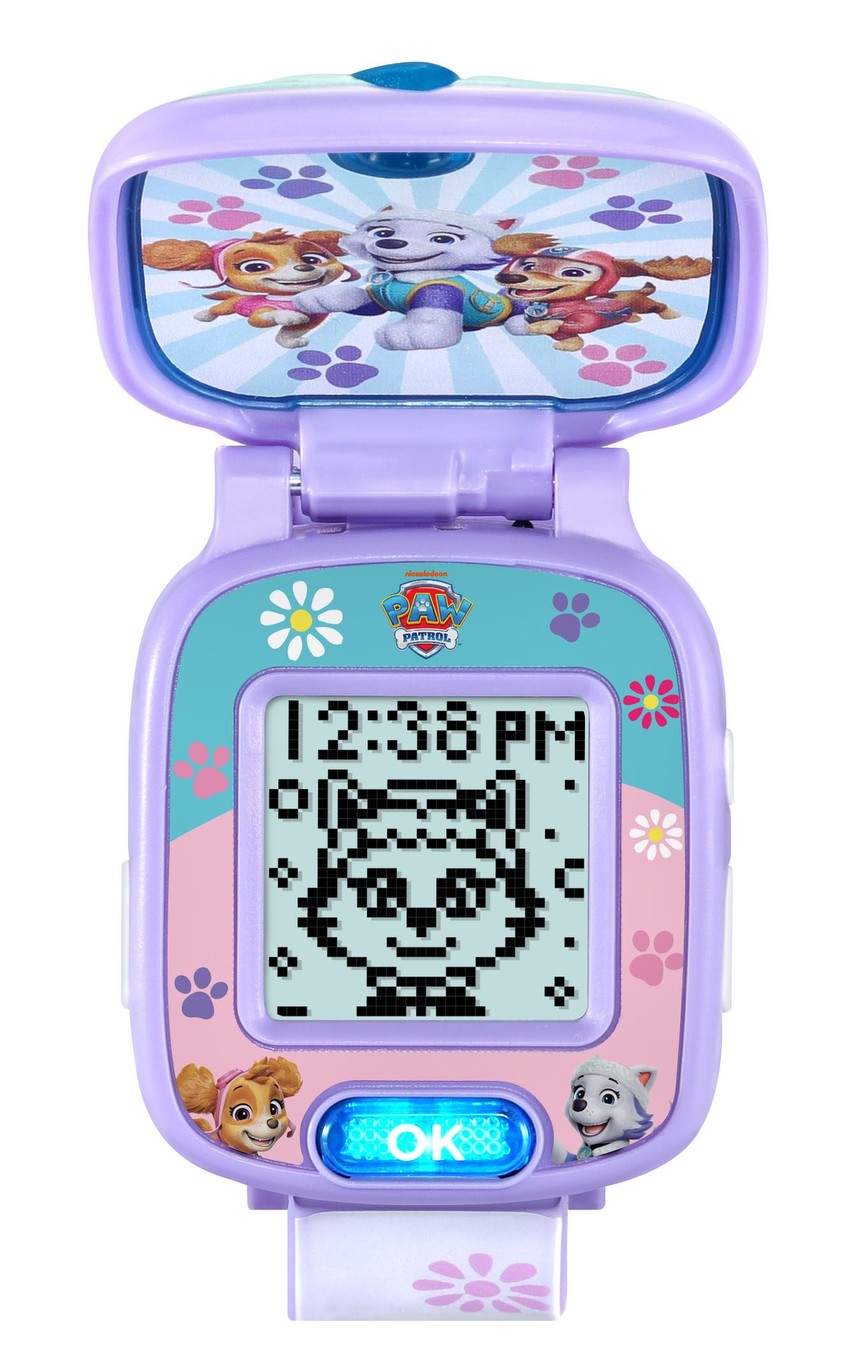
Ice or snow, Everest is ready to go! This wearable gadget, featuring a 3D Everest on the cover, includes 10 digital clock faces, time tools and four games.
Description
Ice or snow, Everest is ready to go! This wearable gadget, featuring a 3D Everest on the cover, includes 10 digital clock faces, time tools and four games. Hear Ryder call the pups into action and guide kids through games to solve puzzles and complete missions. Match pups with their vehicles, help Everest practise her climbing skills, search for matching shapes with Skye and go to a dance party with Liberty. Clock faces feature favourite PAW Patrol pups, and time tools include a stopwatch, timer and an alarm with the choice of alarm tones. No job is too big, no pup too small!

Recommended Products

This is a carousel. Use Next and Previous buttons to navigate. Or, jump to a slide by selecting one of the thumbnails.