This site uses cookies to store information on your computer.

Some of these cookies are essential, while others help us to improve your experience by providing insights into how the site is being used. For more detailed information on the cookies we use, please see our Cookie Policy.

Home
»
VTech Baby
»
Forest Pals Musical Band
3-24
MONTHS

This is a carousel. Use Next and Previous buttons to navigate. Or, jump to a slide by selecting one of the thumbnails.

Forest Pals Musical Band

Developmental Benefits

Auditory Stimulation
Musical Creativity
Musical Creativity
Sensory Development
Sensory Development

Developmental Benefits

Forest Pals Musical Band

Auditory Stimulation
  • Fun and interesting sound effects draw baby’s attention to play.
  • Even very early in life babies can hear a wide variety of sounds. Infants will turn towards the sound of a toy and begin to reach towards it. This ability to recognise the direction that a sound is coming from improves greatly during the first few years of life. Young infants listen longer to the sound of human voice and seem to prefer it to any other sound. They are especially aware of the sound of language and like to be spoken to slowly and with a high pitch. This is sometimes referred to as ‘infant directed speech’ or even ‘baby talk’. Young babies are quite sensitive in their auditory abilities and can perceive all the categorical sound distinctions in world languages. As babies develop their auditory abilities narrow so that eventually babies are only sensitive to those sound categories specific to their native language.
    As soon as babies are born they are influenced by what they hear around them and modify what they able to hear, accordingly. At the same time they become increasingly sensitive to music and musical patterns. Even in their first year babies are distinguishing between musical tunes on the basis of rhythmic patterns and later they begin to recognise the same melody played in a different key. Giving babies plenty of opportunities to hear music, singing, rhythm and talk enhances their learning and prepares them for the social world where they will talk, sing, play and listen to music.
Musical Creativity
  • Enhances musical skills with music and sound activities.
  • Babies are sensitive to sound patterns early in life and respond emotionally to voices. Even before they are born infants detect and monitor sound to a certain extent. During the second half of their first year babies are particularly sensitive to differences in beat and rhythm. Music is a complex form of auditory stimulation that is linked to human movement. Infants are drawn to music and are very good at being able to discern different musical structures. In a recent survey we found that parents often choose a particular traditional nursery, for example twinkle, twinkle little star, because of the gestures linked to the song. Babies love music and nursery rhymes that have plenty of repetition and gestures.
    Children also love to experiment with music. Toys that allow children to create their own tunes facilitate learning. Children can learn about a wide variety of sounds and tempo. They can also learn about the sounds of different musical instruments through pressing keys on a musical toy. Children who grow up in the Western world tend to be exposed to the typical even-beat pattern of Western music. There is a link between learning, singing and rhythm that is related to the type of culture that children grow up in. Musical creativity can be nurtured through the infant’s and child’s exposure to music, musical toys and instruments.
Sensory Development
  • A variety of textures, visuals and sounds stimulate sensory development.
  • Sensory development is intimately related to motor development. Babies are born into a world that stimulates their senses and to which they react. These reactions are bodily movements which create learning experiences. Sensory development in babies can be facilitated through toys that provide opportunities for them to experience sounds, visuals and textures. Young infants need to be presented with an adequate but not too great amount of sensory stimulation.
    From an early age babies use touch to investigate their world; as they learn to reach they begin to run their tongue and lips over toys and then look at them. Tactile stimulation is also combined with other sensory information. Babies can perceive input from different sensory systems in a unified way; for instance, vision and touch are closely coordinated when using a shape sorter. Babies who handle shapes and also fit them through a hole are learning to solve problems through touch and sight. Infants also learn about the links between sights, sounds and feel of toys when these are demonstrated by adults. They begin to associate the sight and sound of a rhythmically shaken rattle or the nursery rhyme played by a particular toy. During the first year of life infants’ visual development is rapid and they begin to identify objects through shape, colour and texture. They also develop the ability to visually track objects. Toys give babies and young children many opportunities to enhance their sensory development.
Best for ages:
3 to 24 Months
Highlights
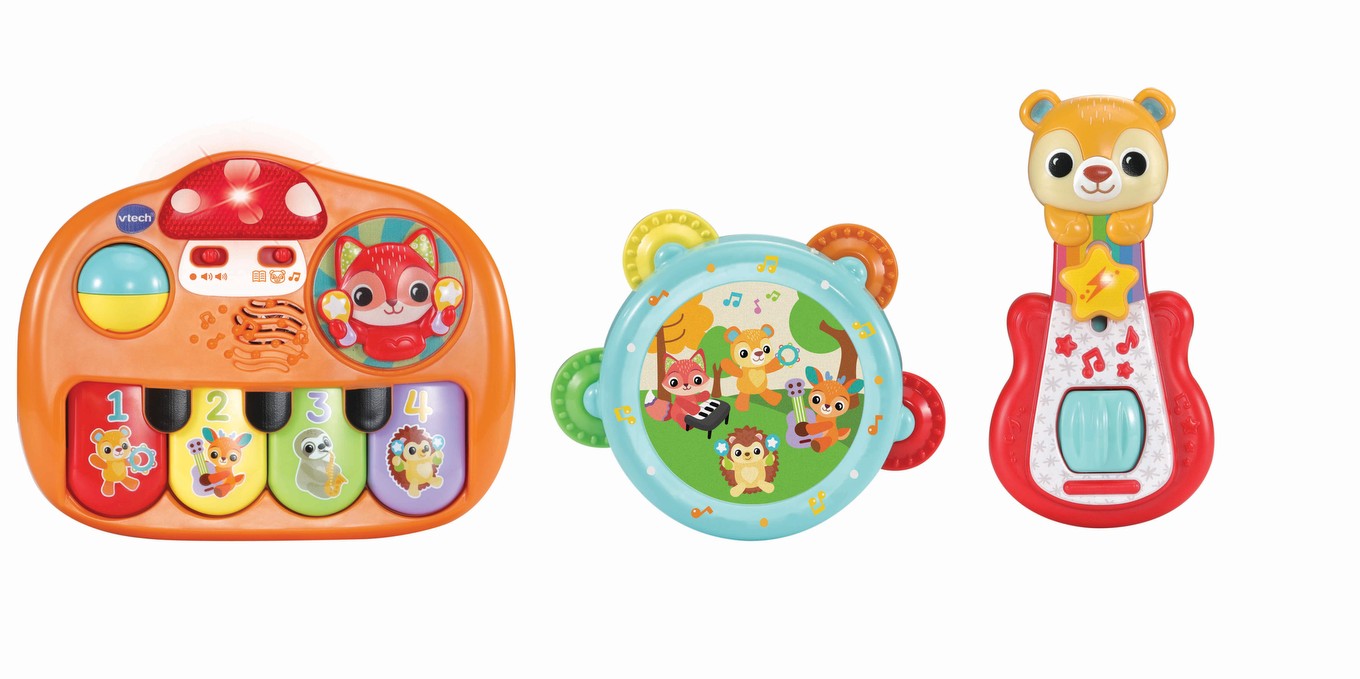
Take the stage right from the floor. Jam on the piano, guitar or tambourine to listen to melodies and phrases in English and Spanish. Explore numbers, colours and animals while watching the lights and hitting all the right notes.
Description
Take the stage right from the floor. Jam on the piano, guitar or tambourine to listen to melodies and phrases in English and Spanish. Explore numbers, colours and animals while watching the lights and hitting all the right notes. There are three available play modes and each instrument creates unique sounds. Adjust the volume for quieter play. Babies explore and discover music to build motor skills and develop language skills too.

Recommended Products

This is a carousel. Use Next and Previous buttons to navigate. Or, jump to a slide by selecting one of the thumbnails.