This site uses cookies to store information on your computer.

Some of these cookies are essential, while others help us to improve your experience by providing insights into how the site is being used. For more detailed information on the cookies we use, please see our Cookie Policy.

Home
»
VTech Baby
»
Touch & Teach Musical Animals Gift Set
3-6
MONTHS

This is a carousel. Use Next and Previous buttons to navigate. Or, jump to a slide by selecting one of the thumbnails.

Touch & Teach Musical Animals Gift Set

Developmental Benefits

Cause & Effect
Cause & Effect
Creative Play
Creative Play
Motor Skills
Motor Skills
Musical Creativity
Musical Creativity
Sensory Development
Sensory Development

Developmental Benefits

Touch & Teach Musical Animals Gift Set

Cause & Effect
  • Rewards baby as they learn that their actions have reactions
  • Babies are exploring and experimenting with the world almost from the day they are born. Cause and effect is a scientific concept that babies learn very early in their lives. A delightful example of this is when babies begin to explore gravity by dropping toys whilst sitting in their highchair. The toy drops downwards and makes a noise as it hits the floor. Parents will tend to pick the toy up and return it to the infant. This enables the baby to continue with their experiment and learn more about cause and effect; babies learn a great deal through repetition and it is good to facilitate opportunities where babies can begin to understand that, for instance, a toy will always fall to the ground. This type of learning through cause and effect continues throughout childhood. Encouraging children to be curious about the world facilitates learning through experience. Toys that reliably make a noise when pressed, pulled or touched teach babies that their actions have an effect on the world. VTech bath toys with their pouring and squirting features encourage cause and effect awareness.
    Children demonstrate that they have understood the concept of cause and effect when they talk about the consequence of actions. Before children use spoken language researchers discover what young infants understand about the world by presenting them with unexpected events. For example, babies are beginning to understand that toys reliably fall to the ground and that if a toy train goes into a tunnel it will come out the other end. If babies are presented with an unexpected event where, for example, a moving toy train disappears behind a screen but does not come out the other end they will stare for a long time at the screen. VTech toys offer babies and children the opportunity to learn more about cause and effect by pressing buttons and listening to the sounds, moving toys around and playing educational computer games.
Creative Play
  • Use imagination in a variety of ways and contexts to communicate ideas
  • When children engage in creative play they are showing that they have the ability to produce something new and original. Children benefit from opportunities where they are free to use their imagination and explore. In order for creative play to occur children need to be in an environment that is rich in stimulation. Curiousity will drive children to take part in creative play.
    Creative play is different from other forms of play; it enables children to develop confidence in their own abilities as they begin to think and work independently. Games and activities that provide choices and also a number of alternative solutions encourage a certain amount of risk-taking. Games with alternative answers can lead children to think creatively and differently. Children need encouragement to play and think creatively. Opportunities to engage in creative play boost children’s confidence and enable them to come up with better ideas. Children benefit from the knowledge they gain through creative play.
Motor Skills
  • Encourages fine motor skill development.
  • An infant’s growth and development in the first year of life is rapid. Many movements that young babies make are in preparation for the next stage of their development. When young babies watch a mobile they are constantly moving their head, arms, legs and even their mouths in response to the movement of the toy. Sound and movement attract a baby’s attention; if a toy is placed almost within reach of babies their movements become more animated. Bath toys provide opportunities to develop and use motor skills to great effect. For example, a young baby has greater control over their leg movements than their arms. You will often see young babies in a bath reaching with their legs towards a floating toy and kicking. All these movements strengthen muscles in readiness for the next stage - walking.
    As babies develop they become more adept at grasping objects. Young infants learn to grasp an object, for instance a cube. The grasping, at first, is quite clumsy but through repetition, and across time, infants become adept at grasping and develop fine motor skills. Infants first use the ulnar grasp where their fingers close against the palm when trying to hold an object. Within another month they are able to move the object from hand to hand. After the first year, infants adopt the ‘pincer grasp’ where they use their thumb and index finger to grasp even very tiny objects. Shape sorters help infants to fine tune their visual perception and hand coordination. Soon infants are building towers with two cubes; this also requires fine coordination skills. As the child grows computer games have been shown to help with hand and eye coordination. Spatial skills can also be enhanced when playing games that require concentration, quick responses and finely tuned motor skills.
Musical Creativity
  • Enhances musical skills with music and sound activities.
  • Babies are sensitive to sound patterns early in life and respond emotionally to voices. Even before they are born infants detect and monitor sound to a certain extent. During the second half of their first year babies are particularly sensitive to differences in beat and rhythm. Music is a complex form of auditory stimulation that is linked to human movement. Infants are drawn to music and are very good at being able to discern different musical structures. In a recent survey we found that parents often choose a particular traditional nursery, for example twinkle, twinkle little star, because of the gestures linked to the song. Babies love music and nursery rhymes that have plenty of repetition and gestures.
    Children also love to experiment with music. Toys that allow children to create their own tunes facilitate learning. Children can learn about a wide variety of sounds and tempo. They can also learn about the sounds of different musical instruments through pressing keys on a musical toy. Children who grow up in the Western world tend to be exposed to the typical even-beat pattern of Western music. There is a link between learning, singing and rhythm that is related to the type of culture that children grow up in. Musical creativity can be nurtured through the infant’s and child’s exposure to music, musical toys and instruments.
Sensory Development
  • A variety of textures, visuals and sounds stimulate sensory development.
  • Sensory development is intimately related to motor development. Babies are born into a world that stimulates their senses and to which they react. These reactions are bodily movements which create learning experiences. Sensory development in babies can be facilitated through toys that provide opportunities for them to experience sounds, visuals and textures. Young infants need to be presented with an adequate but not too great amount of sensory stimulation.
    From an early age babies use touch to investigate their world; as they learn to reach they begin to run their tongue and lips over toys and then look at them. Tactile stimulation is also combined with other sensory information. Babies can perceive input from different sensory systems in a unified way; for instance, vision and touch are closely coordinated when using a shape sorter. Babies who handle shapes and also fit them through a hole are learning to solve problems through touch and sight. Infants also learn about the links between sights, sounds and feel of toys when these are demonstrated by adults. They begin to associate the sight and sound of a rhythmically shaken rattle or the nursery rhyme played by a particular toy. During the first year of life infants’ visual development is rapid and they begin to identify objects through shape, colour and texture. They also develop the ability to visually track objects. Toys give babies and young children many opportunities to enhance their sensory development.
Best for ages:
3 to 6 Months
Highlights
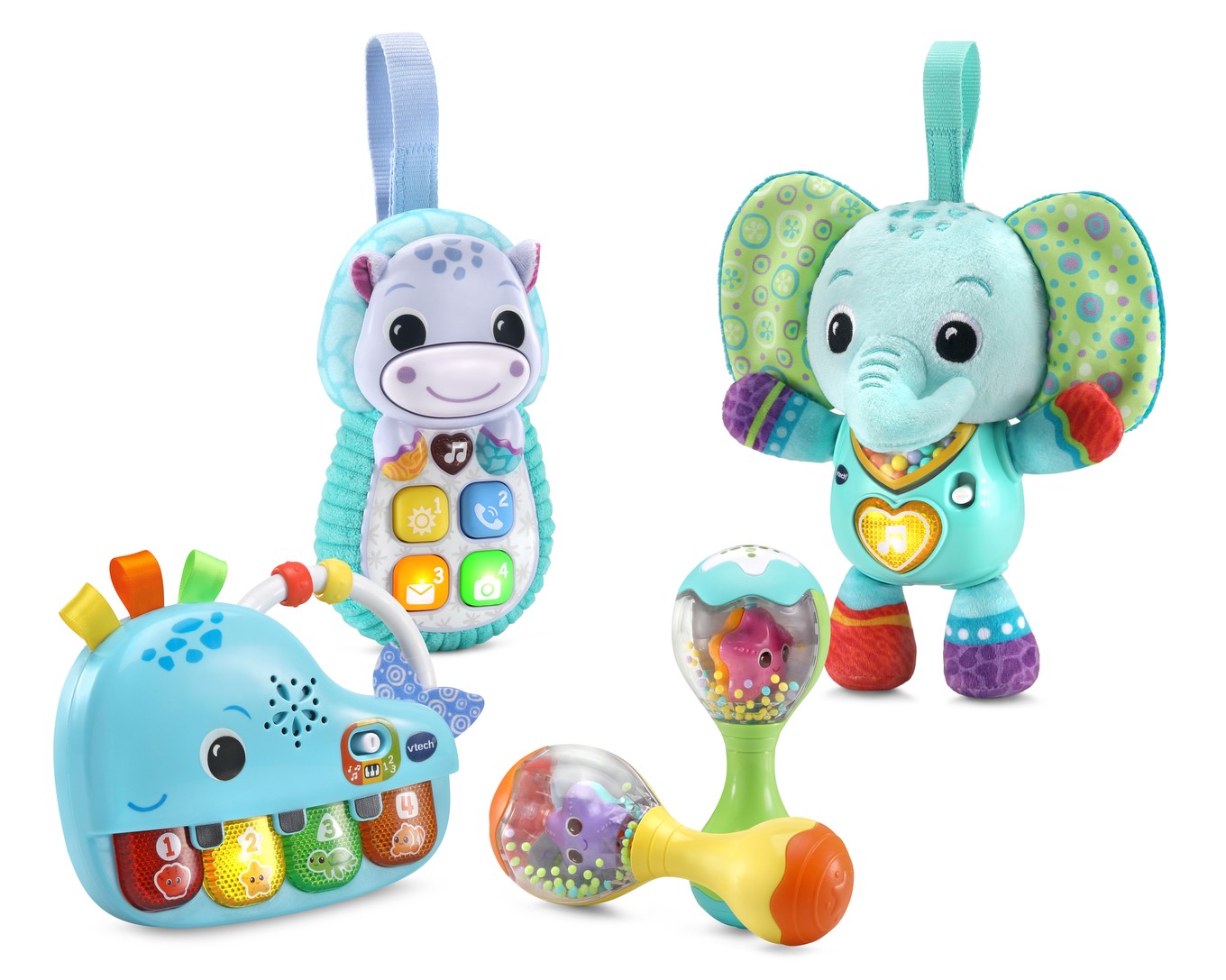
This bundle of animal friends includes a soft cuddly elephant, hippo phone with squishy buttons, whale piano with four keys and sliding beads, and non-electronic starfish maracas. Elephant and hippo have a strap to attach to strollers and carriers, whale piano has a handle and can be tossed into a nappy bag with the maracas.
Description
Bring together the land and the sea with this baby bundle set that includes four animals and five items for curious cuties to cuddle, chat and create music with here, there or anywhere! Go on a sensory safari with the elephant’s crinkly ears, soft head, arms and legs, all while rattling beads and listening to catchy tunes from the big heart button. Take a dive into musical expression on the whale piano with four keys that introduce colours and numbers and let budding musicians compose their own songs. Call friends, listen to messages and explore numbers and colors by pressing squishy buttons on the soft hippo phone. Starfish maracas are simple to use, creating rhythmic rattling beats with every shake. Each animal can be easily toted around for on-the-go play by tossing them into a nappy bag or using the straps to attach them to strollers and carriers. Let’s play!

Recommended Products

This is a carousel. Use Next and Previous buttons to navigate. Or, jump to a slide by selecting one of the thumbnails.