This site uses cookies to store information on your computer.

Some of these cookies are essential, while others help us to improve your experience by providing insights into how the site is being used. For more detailed information on the cookies we use, please see our Cookie Policy.

Home
»
VTech Baby
»
Ultimate Alphabet Activity Cube
9-36
MONTHS

This is a carousel. Use Next and Previous buttons to navigate. Or, jump to a slide by selecting one of the thumbnails.

Ultimate Alphabet Activity Cube

Developmental Benefits

Cause & Effect
Cause & Effect
Cognitive Development
Letters Names Phonics

Developmental Benefits

Ultimate Alphabet Activity Cube

Cause & Effect
  • Rewards baby as they learn that their actions have reactions
  • Babies are exploring and experimenting with the world almost from the day they are born. Cause and effect is a scientific concept that babies learn very early in their lives. A delightful example of this is when babies begin to explore gravity by dropping toys whilst sitting in their highchair. The toy drops downwards and makes a noise as it hits the floor. Parents will tend to pick the toy up and return it to the infant. This enables the baby to continue with their experiment and learn more about cause and effect; babies learn a great deal through repetition and it is good to facilitate opportunities where babies can begin to understand that, for instance, a toy will always fall to the ground. This type of learning through cause and effect continues throughout childhood. Encouraging children to be curious about the world facilitates learning through experience. Toys that reliably make a noise when pressed, pulled or touched teach babies that their actions have an effect on the world. VTech bath toys with their pouring and squirting features encourage cause and effect awareness.
    Children demonstrate that they have understood the concept of cause and effect when they talk about the consequence of actions. Before children use spoken language researchers discover what young infants understand about the world by presenting them with unexpected events. For example, babies are beginning to understand that toys reliably fall to the ground and that if a toy train goes into a tunnel it will come out the other end. If babies are presented with an unexpected event where, for example, a moving toy train disappears behind a screen but does not come out the other end they will stare for a long time at the screen. VTech toys offer babies and children the opportunity to learn more about cause and effect by pressing buttons and listening to the sounds, moving toys around and playing educational computer games.
Cognitive Development
  • Stimulates critical thinking through memory and logic games.
  • An infant’s thinking skills are influenced by physical activity. Cognitive development is the change in abilities such as attention, memory, problem solving and language. Research has shown that infants’ thinking skills develop as they act on the world with their eyes, ears, hands, feet and mouth. Babies learn about the world when they reach, crawl, put objects in their mouths, and drop or bang toys to make a noise. These interactions with the physical world enable babies to begin to understand their surroundings. For example, placing an interesting toy just out of reach of babies stimulate their interest and encourages them to move.
    As the child grows and develops the brain changes in response to the child’s interaction with the world. Learning about the world through play strengthens connections in the brain; this enables infants and children to attain a greater understanding of their surroundings. Cognitive development can be a social activity; adults help infants and children to understand more about their world by presenting them with games and problems that stimulate their thinking and expand their knowledge base. An infant’s and child’s interactions with objects and people, and the consequent changes in the brain, are the building blocks of development.
Letters Names Phonics
  • Teaches letters and their sounds, the building blocks of reading.
  • Phonology is the term used to describe the rules governing the structure and order of speech sounds. The journey towards reading proficiency starts in the pre-school years. Once children understand that there is a correspondence between the marks on a printed/electronic page and spoken language they are able to begin to read. They can then translate the units of print ‘graphemes’ to units of sound ‘phonemes’. Phonological awareness is the ability to detect and use phonemes in words. This skill is crucial for children when learning to make sense of text; they need to be able to relate the sound structure of spoken language to symbols on a page.
    The national curriculum states that children should be taught phonemic awareness and phonic knowledge to decode and encode words. These types of skills can be encouraged in young children by giving them opportunities to notice changes in sounds within words and listen to lots of nursery rhymes. Young children enjoy interacting with toys that give them the opportunity to play with letters and words. The words and letters are often repeated by the child. Young children like to hear letter rhymes and songs repeated over and over again. This is all part of their learning experience and is preparing the young child to become proficient at sounding out words.
Best for ages:
9 to 36 Months
Highlights
Get the building blocks of learning with the Ultimate Alphabet Activity Cube by VTech!
Description
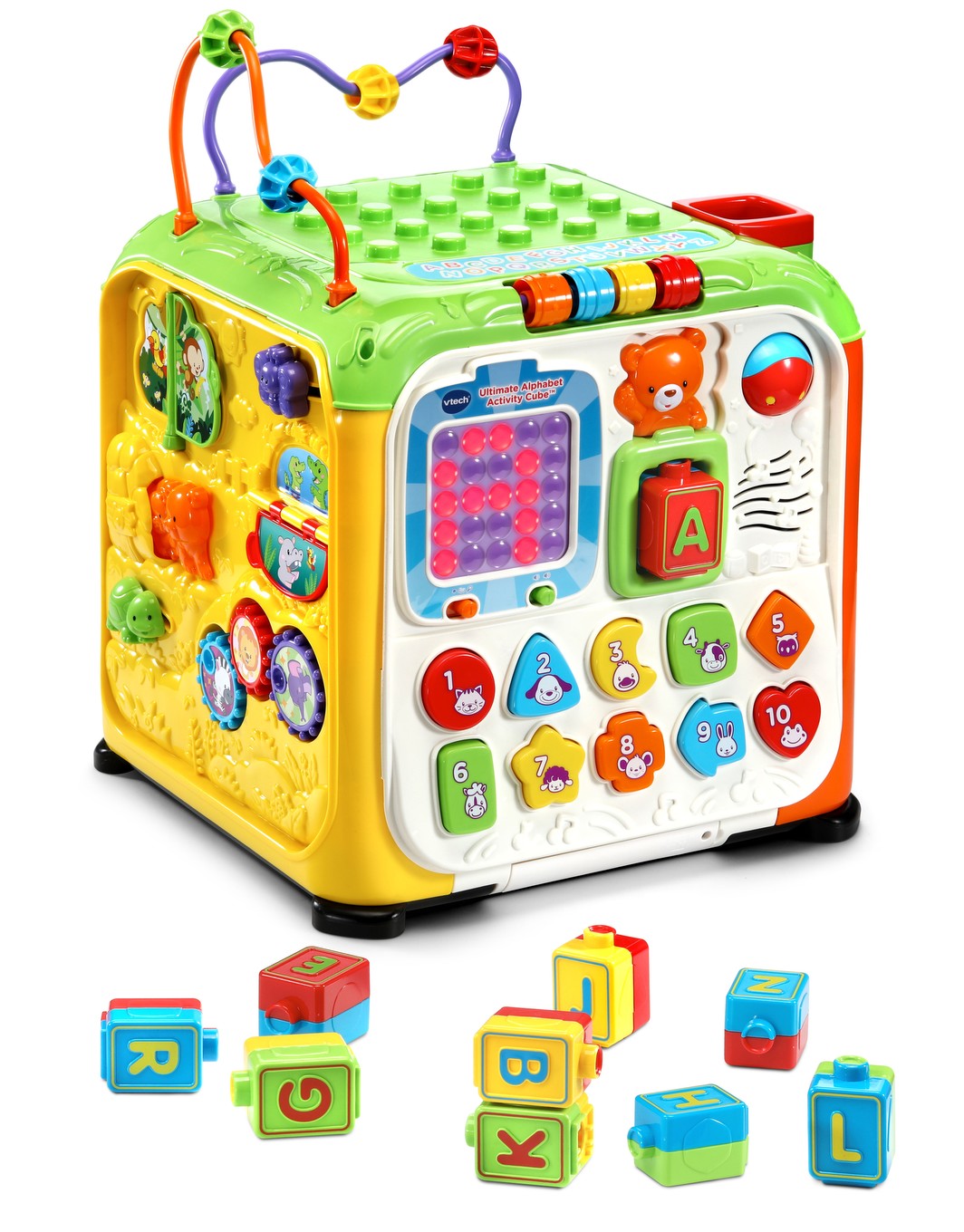
Get the building blocks of learning with the Ultimate Alphabet Activity Cube by VTech. This cube has five interactive sides and includes 13 double-sided letter blocks that provide a variety of developmental benefits for years of play. Insert the blocks into the letter recognition slot and the cube will show the letter on the LED screen and introduce it through a playful song. Drop the letter blocks into the chute and each block will be counted or will play sounds as it drops down the peg maze. Press the ten colourful shape buttons to learn about numbers, colours, shapes, animal names and sounds, and hear simple questions that will keep toddlers engaged. Other sides of the cube feature animals to slide or flip, block-sorter holes, gears and more. The cube also has storage to hold all the blocks when they’re done playing. Your little one will have fun exploring all the ways there are to learn!

Recommended Products

This is a carousel. Use Next and Previous buttons to navigate. Or, jump to a slide by selecting one of the thumbnails.