This site uses cookies to store information on your computer.

Some of these cookies are essential, while others help us to improve your experience by providing insights into how the site is being used. For more detailed information on the cookies we use, please see our Cookie Policy.

Home
»
VTech Baby
»
Rainbow Colours Axolotl Teether Pink
3-24
MONTHS

This is a carousel. Use Next and Previous buttons to navigate. Or, jump to a slide by selecting one of the thumbnails.

Rainbow Colours Axolotl Teether

Developmental Benefits

Language Development
Tactile Stimulation
Tactile Stimulation
Visualisation Memory

Developmental Benefits

Rainbow Colours Axolotl Teether

Language Development
  • Introduces the alphabet, letter sounds and vocabulary.
  • Babies start to babble at an early age and this can be seen as the first signs of language. They are predisposed to pick up the sounds of the language that they hear around them. Adults can facilitate babies’ language development by playing with them, focussing on particular toys, reading books and naming everyday objects. The more babies are exposed to language the faster they will begin to pick up it up. There are social skills involved in language acquisition such as realising that it is necessary to wait until the other person has finished speaking. Babies begin to learn about conversational turn-taking from an early age; if a baby is babbling the adult waits for a pause and then talks to the baby. Babies learn to take turns even before they are using words. Social interaction is important for language development and turn-taking games are a fun and educational way for babies and young children to learn.
    Young children also need to practice their language skills. Toys that name alphabet letters and everyday words satisfy young children’s need for repetition and rehearsal when practicing words and sounds. For instance, young children can press a button repetitively to hear the same sound or word again. Babies and children learn a lot through repetition and pick up words rapidly in this way. Once children begin to read their vocabulary expands enormously.
Tactile Stimulation
  • Mixture of different textures provide stimulation for baby.
  • Babies learn about the world through their senses. The sense of touch is intimately linked with other senses such as sound and vision. Babies are provided with stimulation from more than one sensory system at the same time; this is termed intermodal perception. They learn about the sounds that different objects make when they bang or touch them. Toys that are have different textures and shapes facilitate infants’ learning. Babies put toys and other objects in their mouths from an early age. They also begin to reach for and grasp objects and then move toys from one hand to another. Toys that are made of different materials and are different shapes stimulate young infants to grasp, mouth and shake them. Babies then gain greater motor control and begin to pick up small objects with their thumb and index finger. They also begin to bang objects together. This combines tactile and auditory stimulation; they feel the vibration and also hear the sound.
    Bath time play is an excellent opportunity for tactile stimulation. Bath toys that are small and lightweight so that young babies can grasp them are excellent stimulus materials. Babies and young children can learn from handling toys in the water; there are many opportunities for grasping, squeezing and squirting water from objects. Tactile stimulation and learning is also experienced when infants and young children feel the weight of a toy when they have filled it with water and then after they have poured the water away. These types of experiences help young children to learn about the shape, pattern, surface, texture and weight of objects through touching them.
Visualisation Memory
  • Engaging graphics & visualisation activities develop memory.
  • As babies develop they begin to use mental pictures of objects that are no longer within their field of vision. These memory skills can be enhanced through presenting visual stimuli more than once; repetition is essential for the development of memory skills. Young infants’ memories are influenced by context; for instance, they can imitate an adult’s actions with a toy but only if the toy is identical in colour and features to the one that the adult played with. Older infants can remember, for instance, how to press a toy animal to make a sound even if the toy is slightly different to the one which the adult used to demonstrate. Infants’ memories become less context dependent at the same time that infants start to crawl and walk. Giving babies plenty of opportunity to explore their world allows them to enhance their memory skills.
    As children’s attention span increases so do their memory strategies. This means that children can use deliberate mental activities, such as visualisation, to increase the chances of retaining information in working memory and then shifting it to their long-term knowledge base. Lots of rehearsal and organisation is needed to use memory to its full advantage; repetition is an important part of both infant and childhood learning. Children can both learn and practice memory strategies using toys and games. Toys that encourage children to remember visual stimuli, answer questions and then repeat the activity over again enhance learning.
Best for ages:
3 to 24 Months
Highlights
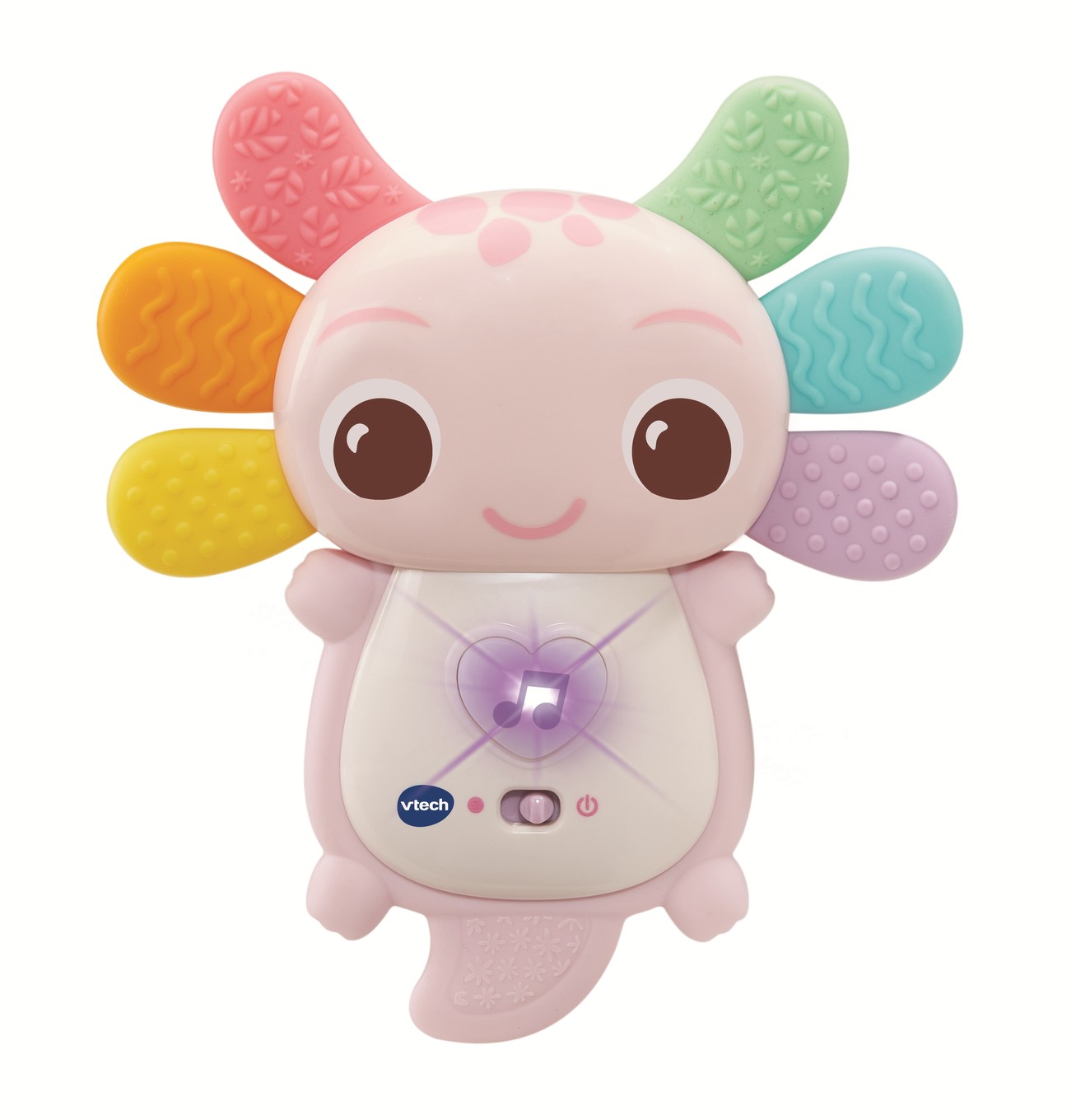
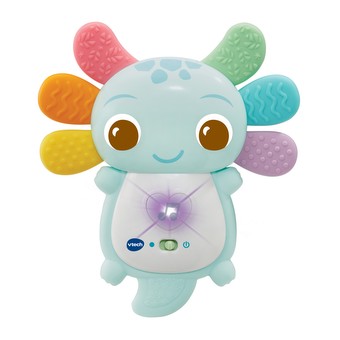
Have lots of fun wth the VTech Rainbow Colours Axolotl Teether! Designed with soft, textured silicone gills, this adorable teether offers tactile stimulation, perfect for tiny hands.
Description
Introduce your little one to a world of colour, music, and discovery with VTech’s Rainbow Colours Axolotl Teether! Designed with soft, textured material gills, this adorable teether offers tactile stimulation perfect for tiny hands. The axolotl helps introduce colours and fun facts, making early learning engaging and playful. A variety of textures encourage tactile exploration and development. A heart button that lights up and changes colour with every press encourages interactive play. Features 3 sing-along songs and 10 upbeat melodies to keep babies entertained. Suitable for teething and early learning activities, this charming companion supports developmental growth through music, texture, and exploration.

Recommended Products

This is a carousel. Use Next and Previous buttons to navigate. Or, jump to a slide by selecting one of the thumbnails.