This site uses cookies to store information on your computer.

Some of these cookies are essential, while others help us to improve your experience by providing insights into how the site is being used. For more detailed information on the cookies we use, please see our Cookie Policy.

Home
»
Toot-Toot Drivers
»
Toot-Toot Drivers Police Station & Firehouse Bundle
1-5
YEARS

This is a carousel. Use Next and Previous buttons to navigate. Or, jump to a slide by selecting one of the thumbnails.

Toot-Toot Drivers Police Station & Firehouse Bundle

Developmental Benefits

Discovery Exploration
Imaginitive Play
Imaginitive Play
Independent Play
Independent Play
Language Development

Developmental Benefits

Toot-Toot Drivers Police Station & Firehouse Bundle

Discovery Exploration
  • Heightens curiosity and encourages exploration.
  • Even young babies love to learn about the world through exploration. Kicking and waving their arms while lying in their cot can lead them to discover that a kick can make a banging sound. Exploration and play are closely linked in infants where, for example, discovering that a toy makes a noise leads to infants repeating the action that made the noise. Babies learn a great deal through repetition. Once babies are either crawling or walking their mobility gives them more opportunities to explore their world.
    Babies need to satisfy their curiosity about an object or toy by approaching and handling it. Adults can influence an infant’s confidence about the world by encouraging and smiling at them when they approach an unfamiliar object or toy. Babies can show uncertainty about a new toy and in order for them to confidently explore and discover it they need the emotional reassurance from their parent or caregiver. The confidence to explore and discover new things develops during infancy and creates a healthy curiousity about the world throughout childhood.
Imaginitive Play
  • Imagination and exploration through interaction with characters.
  • Children’s imagination is active from an early age. Imaginative play has links to what psychologists call ‘social pretend play’. Young children pretend or imagine that, for instance a wooden block is a cake and they carefully ‘cut’ it. A large proportion of pretend play tends to be social. Imaginative play begins when infants play and pretend with adults. As young children develop they begin to try to engage other children in social pretend play. Young children in nursery benefit from engaging in imaginative play. It helps them to begin to understand that other children think differently to them and have different ideas.
    Children can engage in imaginative play with other children where they have agreed on a story or scenario that they want to act out. Young children playing with toys use their imagination to invent scenarios and play out the consequences. They can use characters to explore scenarios and act out scripts such as going shopping or bedtime. Imaginative and social pretend play is beneficial for children as it allows them to explore different ways of viewing the world. Children who use their imagination when playing with other children are increasing their social competence and their understanding of other people. In a study where we observed children playing in a nursery we found that young children engaged in imaginative play, often using the toys in unexpected ways. Children’s imagination benefits from the opportunity to play with all types of toys.
Independent Play
  • Games and voice prompts allow children to control the pace.
  • Early play in infants tends to be solitary or takes place alongside other children. Young children learn how to interact with other children through play but they can also explore and learn independently. The initial play experience for infants is when they begin to explore through moving and acting upon the world. Many toys offer infants the opportunity to learn more about their world. Young children will sometimes act out some aspect of their lives e.g. going to the shops and then they involve their toys in these activities. These young children are playing independently but they are also reinforcing their understanding of the social world by acting out scenarios.
    Young children can consolidate their existing skills by repeating actions whilst playing a game. Learning to play independently has its benefits, for instance, children using an educational game can control their own pace. Children sometimes choose to work independently in order to build up their confidence. Toys and computer games that facilitate independent activity at the right level for the child enhance problem solving skills and increase hand and eye coordination. Although cooperative play increases during childhood, children still spend the equivalent amount of time in solitary or independent play.
Language Development
  • Introduces the alphabet, letter sounds and vocabulary.
  • Babies start to babble at an early age and this can be seen as the first signs of language. They are predisposed to pick up the sounds of the language that they hear around them. Adults can facilitate babies’ language development by playing with them, focussing on particular toys, reading books and naming everyday objects. The more babies are exposed to language the faster they will begin to pick up it up. There are social skills involved in language acquisition such as realising that it is necessary to wait until the other person has finished speaking. Babies begin to learn about conversational turn-taking from an early age; if a baby is babbling the adult waits for a pause and then talks to the baby. Babies learn to take turns even before they are using words. Social interaction is important for language development and turn-taking games are a fun and educational way for babies and young children to learn.
    Young children also need to practice their language skills. Toys that name alphabet letters and everyday words satisfy young children’s need for repetition and rehearsal when practicing words and sounds. For instance, young children can press a button repetitively to hear the same sound or word again. Babies and children learn a lot through repetition and pick up words rapidly in this way. Once children begin to read their vocabulary expands enormously.
Best for ages:
1 to 5 Years
Highlights
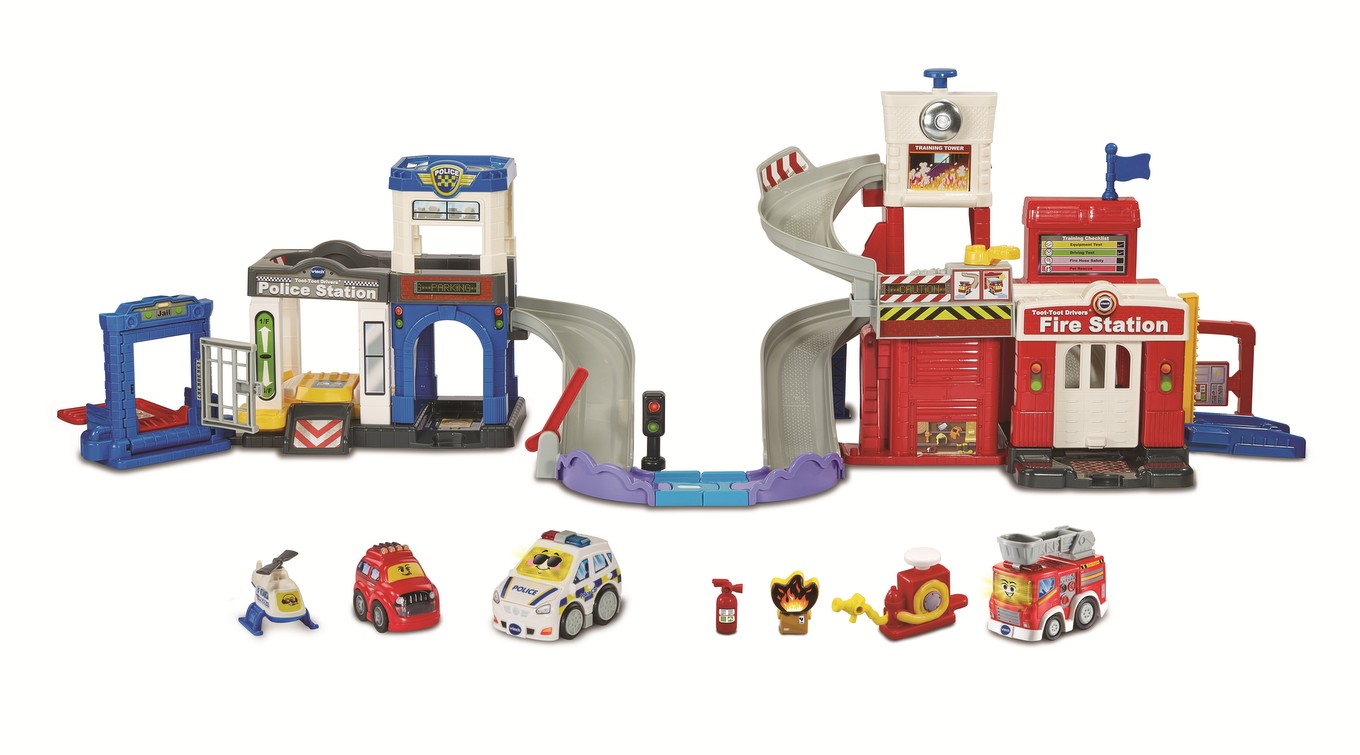
Race to the rescue and chase down criminals with this exciting Toot-Toot Drivers Police Station & Fire Station bundle! Packed with action and role-play fun, this set includes a SmartPoint Police Car, Fire Engine, mini getaway car and mini helicopter to bring every adventure to life.
Description
Race to the rescue and chase down criminals with this exciting Toot-Toot Drivers Police Station & Fire Station bundle! Packed with action and role-play fun, this set includes a SmartPoint Police Car, Fire Engine, mini getaway car and mini helicopter to bring every adventure to life. Zoom into action as multiple SmartPoint locations across both playsets trigger fun phrases, songs, melodies and realistic sound effects as vehicles drive over them. Break criminals out of jail with the quick-release door, speed down ramps to emergencies, or transport vehicles between levels using the spinning lift. Then hurry to the scene of the fire—ring the bell and launch the Fire Engine down the ramp, ready to save the day! With interactive features like a spiral track that links to the lift, a route-changing lever, twisting flag, swing-up doors, flip-down fire and fuel pump, plus accessories including a fire and extinguisher, there’s endless imaginative play to explore. Both vehicles include sing-along songs and cheerful melodies for even more fun.

Recommended Products

This is a carousel. Use Next and Previous buttons to navigate. Or, jump to a slide by selecting one of the thumbnails.