This site uses cookies to store information on your computer.

Some of these cookies are essential, while others help us to improve your experience by providing insights into how the site is being used. For more detailed information on the cookies we use, please see our Cookie Policy.

Home
»
Others
»
Peppa Pig: Little Singing Peppa
3+
MONTHS

This is a carousel. Use Next and Previous buttons to navigate. Or, jump to a slide by selecting one of the thumbnails.

Peppa Pig: Little Singing Peppa

Developmental Benefits

Language Development
Motor Skills
Motor Skills
Musical Creativity
Musical Creativity

Developmental Benefits

Peppa Pig: Little Singing Peppa

Language Development
  • Introduces the alphabet, letter sounds and vocabulary.
  • Babies start to babble at an early age and this can be seen as the first signs of language. They are predisposed to pick up the sounds of the language that they hear around them. Adults can facilitate babies’ language development by playing with them, focussing on particular toys, reading books and naming everyday objects. The more babies are exposed to language the faster they will begin to pick up it up. There are social skills involved in language acquisition such as realising that it is necessary to wait until the other person has finished speaking. Babies begin to learn about conversational turn-taking from an early age; if a baby is babbling the adult waits for a pause and then talks to the baby. Babies learn to take turns even before they are using words. Social interaction is important for language development and turn-taking games are a fun and educational way for babies and young children to learn.
    Young children also need to practice their language skills. Toys that name alphabet letters and everyday words satisfy young children’s need for repetition and rehearsal when practicing words and sounds. For instance, young children can press a button repetitively to hear the same sound or word again. Babies and children learn a lot through repetition and pick up words rapidly in this way. Once children begin to read their vocabulary expands enormously.
Motor Skills
  • Encourages fine motor skill development.
  • An infant’s growth and development in the first year of life is rapid. Many movements that young babies make are in preparation for the next stage of their development. When young babies watch a mobile they are constantly moving their head, arms, legs and even their mouths in response to the movement of the toy. Sound and movement attract a baby’s attention; if a toy is placed almost within reach of babies their movements become more animated. Bath toys provide opportunities to develop and use motor skills to great effect. For example, a young baby has greater control over their leg movements than their arms. You will often see young babies in a bath reaching with their legs towards a floating toy and kicking. All these movements strengthen muscles in readiness for the next stage - walking.
    As babies develop they become more adept at grasping objects. Young infants learn to grasp an object, for instance a cube. The grasping, at first, is quite clumsy but through repetition, and across time, infants become adept at grasping and develop fine motor skills. Infants first use the ulnar grasp where their fingers close against the palm when trying to hold an object. Within another month they are able to move the object from hand to hand. After the first year, infants adopt the ‘pincer grasp’ where they use their thumb and index finger to grasp even very tiny objects. Shape sorters help infants to fine tune their visual perception and hand coordination. Soon infants are building towers with two cubes; this also requires fine coordination skills. As the child grows computer games have been shown to help with hand and eye coordination. Spatial skills can also be enhanced when playing games that require concentration, quick responses and finely tuned motor skills.
Musical Creativity
  • Enhances musical skills with music and sound activities.
  • Babies are sensitive to sound patterns early in life and respond emotionally to voices. Even before they are born infants detect and monitor sound to a certain extent. During the second half of their first year babies are particularly sensitive to differences in beat and rhythm. Music is a complex form of auditory stimulation that is linked to human movement. Infants are drawn to music and are very good at being able to discern different musical structures. In a recent survey we found that parents often choose a particular traditional nursery, for example twinkle, twinkle little star, because of the gestures linked to the song. Babies love music and nursery rhymes that have plenty of repetition and gestures.
    Children also love to experiment with music. Toys that allow children to create their own tunes facilitate learning. Children can learn about a wide variety of sounds and tempo. They can also learn about the sounds of different musical instruments through pressing keys on a musical toy. Children who grow up in the Western world tend to be exposed to the typical even-beat pattern of Western music. There is a link between learning, singing and rhythm that is related to the type of culture that children grow up in. Musical creativity can be nurtured through the infant’s and child’s exposure to music, musical toys and instruments.
Best for ages:
3+ Months
Highlights
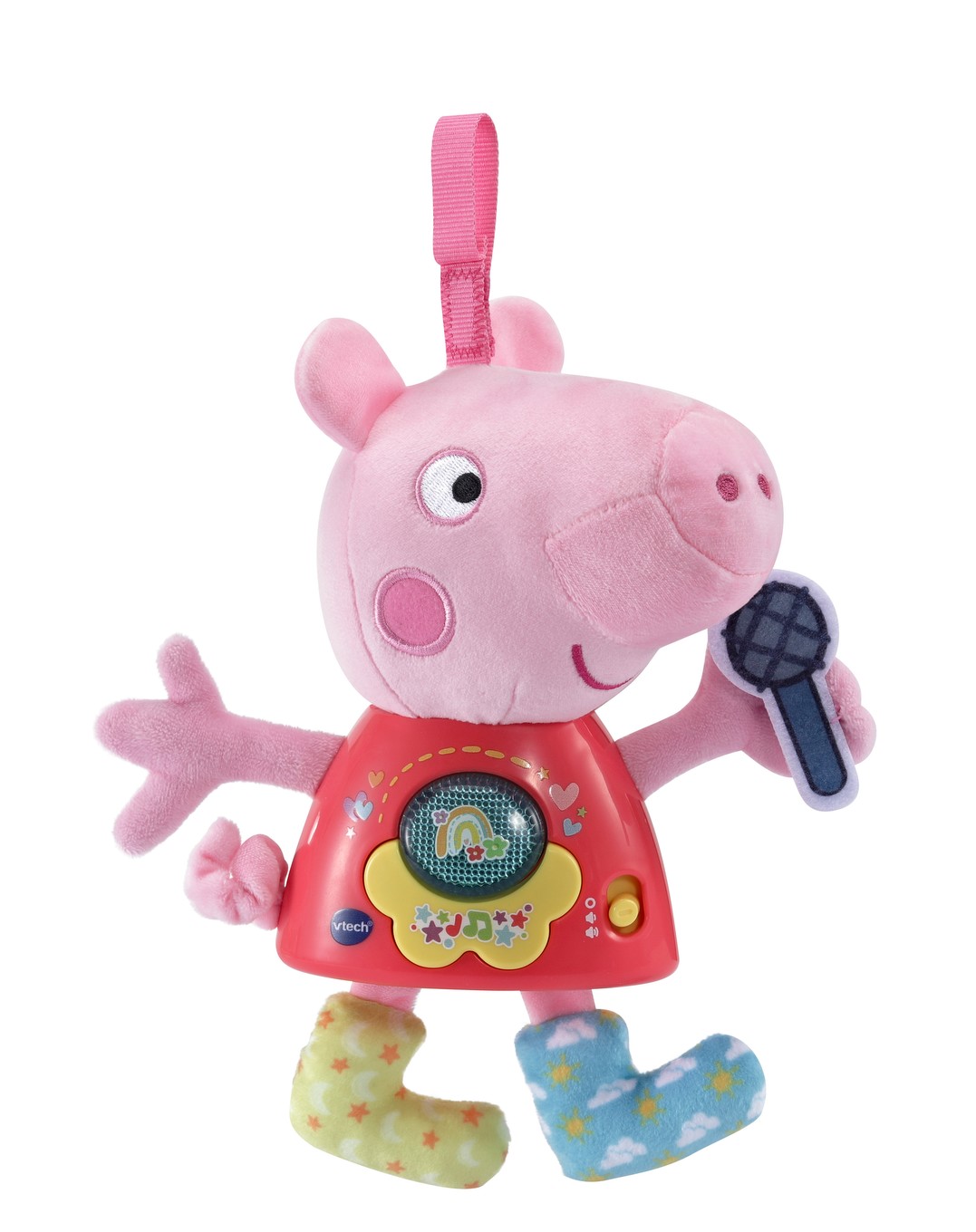
Sing and giggle to songs and phrases with Little Singing Peppa! Explore soft plush, crinkle ears and a curly tail. Use the hang tag to take Peppa everywhere.
Description
Designed to support early language development, Little Singing Peppa introduces first words with delightful music, fun phrases, and interactive sounds. Press the Music Button to hear 10 catchy melodies and 3 songs sung by Peppa Pig - perfect for little singers to enjoy! Press the magical Light Up Button to hear fun and loving phrases with colour changing lights. Keep little hands busy and senses engaged with the super-soft plush, curly tail, crinkle ears and a fun microphone for extra tactile discovery. With a handy hang tag for take-along play, Peppa is always ready for on-the-go fun!

Recommended Products

This is a carousel. Use Next and Previous buttons to navigate. Or, jump to a slide by selecting one of the thumbnails.

  • Rainbow Colours Axolotl Teether Pink
    Rainbow Colours Axolotl Teether Pink
    Ages 3 to 24 Months
  • Touch & Teach Musical Animals Gift Set
    Touch & Teach Musical Animals Gift Set
    Ages 3 to 6 Months
  • Forest Pals Musical Band
    Forest Pals Musical Band
    Ages 3 to 24 Months
  • Discovery Play Centre
    Discovery Play Centre
    Ages 3 to 36 Months